
Design thinking is a way to solve problems that starts with the people who have them. A team learns about those people, defines the problem, tries ideas and tests them. I follow design thinking as a practical approach, not as a fixed set of methods. I break a problem into parts with logic and solve it step by step.
I studied research for design and innovation at Elisava in Barcelona, and I worked as an innovation and strategy consultant. I am a Senior Product Designer, currently at Vodafone. When a project arrives, I research what other companies do and what the business needs. Then I guide where the product goes.
This article explains the common models of design thinking and how they compare. It covers the main criticism, the habit I recommend for breaking down a problem, and when a full workshop is the wrong tool.
What is design thinking?
Design thinking is a way to solve problems that puts people at the centre. You learn about the people who have the problem first, and then you make and test answers with them.
IDEO, a design company that also teaches the method, calls design thinking “a human-centered approach to solving complex problems”. In IDEO’s words, it joins three things: what is desirable for people, what is viable for organizations and what is feasible with technology. In plain words: people want it, the business can earn money from it, and it can be built.
The word “design” can mislead. IDEO’s own site says design thinking is not limited to designers. Product managers, engineers and business leaders use it too.
The stages of design thinking: d.school and the Double Diamond
Two models are a good place to start. The Stanford d.school names five modes of design thinking. The Design Council, the UK’s national charity for design, started to share its Double Diamond in 2004, with four phases. Both models start with the people and the problem, and both end with a tested answer.
| What the team does | Stanford d.school, five modes | Double Diamond, four phases |
|---|---|---|
| Learns about the people and the problem | Empathize | Discover |
| Says which problem to solve | Define | Define |
| Looks for many possible answers | Ideate | Develop |
| Makes answers real and tests them | Prototype and Test | Deliver |
| What the model says about order | Start in any mode | Not a linear process |
The rows are my own reading, and the two models do not match one to one. Other sources count other stages. IDEO’s site lists seven phases, and the first one is “Frame the question”. So there is no single list of steps.
The Double Diamond makes one point clearer than the other models. The first diamond is about the problem, and the second is about the answers. In the Design Council’s history of the model, the first half ends with a design brief that defines the challenge. I explain how to write one in how to write a design brief.
How I use design thinking to break down a problem
I use design thinking as a habit: I break a problem into parts with logic, and I solve the parts one at a time. The six steps below are the method I recommend.
- Name the problem One sentence. Who has it, when it happens and what the business needs. No solution.
- Split it into parts Parts that do not overlap and that together cover the whole problem.
- Order the parts Start with the part that blocks the others, or with the part that carries the most risk.
- Research each part What other companies do, what the business needs and what customers say.
- Solve one part at a time Make a small prototype for each part, and test it before the next part.
- Join the parts One direction for the product, with the evidence from each part.
The d.school has the same idea on one card of its 2018 teaching deck. It tells teams to “break down the larger challenge into smaller actionable bits” before they look for ideas.
For example, an online shop hears that “the checkout needs a redesign”. That sentence is a solution. The problem behind it could be “new customers leave before they pay”. It splits into parts that do not overlap. The customer sees the full price late. The customer must create an account. The customer’s card is not accepted. Each part needs its own research and its own small test. Some parts need no screen at all, only a business decision.
Step 4 is the research I do when a project arrives: what other companies do and what the business needs. I describe it in product strategy for designers.
Is design thinking dead? The main criticism
Design thinking is not dead, but the criticism is fair. The main complaint is that design thinking workshops produce ideas that nobody builds.
In 2023, Rebecca Ackermann wrote in MIT Technology Review that execution has always been the weak point of design thinking. Some versions of the process do not even include the last step, implementation. She reports that Jake Knapp ran design thinking workshops at Google, and that the sessions did not usually lead to built products. The article is journalism, and most of its cases come from schools, government and social projects.
An older criticism is about the name. In 2010, Don Norman wrote on the design site Core77 that design thinking is a public relations term for the creative thinking that people in every field have always done. He also wrote that the term was useful, because it helps people see design as more than form and style.
My answer to both points is to keep the habit and drop the ritual. The owners of the models say something similar. IDEO calls design thinking “a creative practice, not a checklist”. The Design Council writes that the Double Diamond “is not a linear process”.
A workshop is one tool inside the approach. The work counts when the team builds and tests the answer. The mistake I see most in product design is a design that looks good and ignores the strategy of the product. A workshop with no link to the business goal repeats that mistake, faster and with more people.
When not to run a full design thinking workshop
Run a full workshop when the problem is new to the team and touches several teams. For a problem that one team knows well, the habit is enough.
| How many teams it touches | How well the team knows the problem: Little | How well the team knows the problem: Well |
|---|---|---|
| How many teams it touches: Several | A full workshop (highlighted) The problem is new and shared. People from each team learn it together. | A short alignment session The problem is known. Agree on the parts and on an owner for each part. |
| How many teams it touches: One | Research first Talk to customers and study other companies before any session. | The habit is enough Split the problem and solve the parts in the normal work of the team. |
Three cases need no workshop at all. The decision is already made. Nobody will build the result. Or the team cannot reach the people who have the problem, so research comes first. A workshop in these cases produces ideas with no owner, which is the criticism above.
How to start this week
Start with one problem and one small test.
- Choose one problem on your list that feels too big to start.
- Write it in one sentence: who has it, when it happens and what the business needs.
- Split it into three to five parts that do not overlap.
- Choose the part that blocks the others, and research it for one day.
- Test one small answer for that part before the end of the week.
Infographic
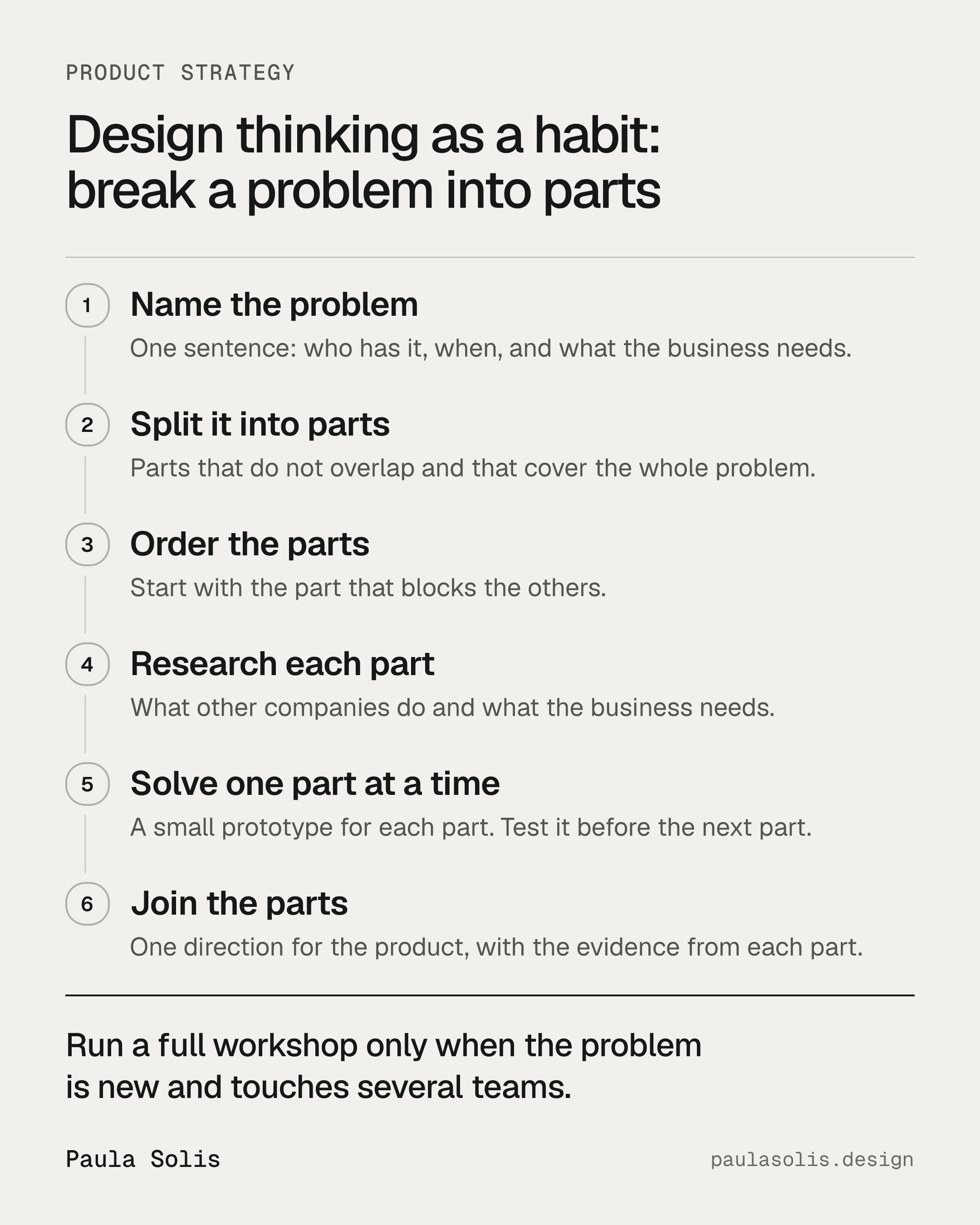
Design thinking as a habit: break a problem into parts. 1. Name the problem: One sentence: who has it, when, and what the business needs. 2. Split it into parts: Parts that do not overlap and that cover the whole problem. 3. Order the parts: Start with the part that blocks the others. 4. Research each part: What other companies do and what the business needs. 5. Solve one part at a time: A small prototype for each part. Test it before the next part. 6. Join the parts: One direction for the product, with the evidence from each part. Run a full workshop only when the problem is new and touches several teams.
Questions and answers
What is design thinking?
Design thinking is a way to solve problems that starts with the people who have them. A team learns about those people, defines the problem, looks for many ideas, makes simple prototypes and tests them. IDEO describes design thinking as a human-centered approach that joins what people need, what technology can do and what a business needs.
What are the stages of design thinking?
The stages of design thinking depend on the model. The Stanford d.school names five modes, empathize, define, ideate, prototype and test. The Double Diamond of the Design Council has four phases, discover, define, develop and deliver. IDEO lists seven phases. Each of these sources says that teams move back and forth between the stages.
What is the difference between design thinking and the Double Diamond?
Design thinking is the wider approach to solving problems with people at the centre. The Double Diamond is one model of the design process, shared by the UK Design Council from 2004. The first half of the Double Diamond finds and defines the right problem. The second half develops answers and tests them.
Is design thinking dead?
Design thinking is not dead, but the criticism of it is fair. A 2023 article in MIT Technology Review reports that design thinking workshops often produced ideas that nobody built. I recommend design thinking as a habit to understand and split a problem, used by the same team that builds and tests the answer.
When should a team not run a design thinking workshop?
A team should not run a full design thinking workshop when the problem is small or well known, when the decision is already made, or when nobody will build the result. In those cases, write the problem in one sentence, split it into parts and solve the parts in the normal work of the team.
Sources (9)
- Design Thinking by IDEO (opens in a new tab). IDEO.
- The design thinking process (opens in a new tab). IDEO.
- Design Thinking Bootleg (opens in a new tab). Stanford d.school, 2025.
- Design Thinking Bootleg, 2018 deck (opens in a new tab). Stanford d.school, 2018.
- The Double Diamond (opens in a new tab). Design Council.
- History of the Double Diamond (opens in a new tab). Design Council.
- Framework for Innovation (opens in a new tab). Design Council.
- Design thinking was supposed to fix the world. Where did it go wrong? (opens in a new tab). MIT Technology Review, 2023.
- Design Thinking: A Useful Myth (opens in a new tab). Core77, 2010.