
Product strategy for designers is the work that comes before the first screen: research on other companies and on the business, and one clear direction for the product.
Most design work is judged by its screens. In my experience the decisions that matter most happen earlier, before anyone opens a design file.
I am a Senior Product Designer at Vodafone. I work from Madrid with the strategy team of Vodafone UK. When a project arrives, my first job is to give guidance on where the product should go. This article explains how I do that.
What product strategy means for a designer
Product strategy answers three things: which problem the product solves, for whom, and why the business gains from it.
A designer does not own that answer alone. Product managers, engineers and business teams own parts of it. The designer brings the view of the customer and the ability to make an idea visible. Both are useful only when they connect to what the business needs.
Design strategy is the next question: how the experience will make the product strategy true. The two overlap in practice.
| Product strategy | Design strategy | |
|---|---|---|
| Question | Which problem, for whom, and why the business gains | How the experience makes that true |
| Evidence | The market, the business numbers, the customer need | Other products, customer behaviour, what the teams can build |
| Result | A problem and a goal | A direction and the decisions it implies |
The two questions I ask when a project arrives
What do other companies do?
I look at how other companies solve the same problem. I include direct competitors and companies from other sectors that solve a similar problem well.
I do not collect screenshots to copy them. I look for patterns. Which steps does every company ask for? Which steps did one company remove? What do customers already expect because another product taught them?
This research shows what is standard, where a product can be different, and what that difference costs.
What does the business need?
Then I ask what the company needs from this project. More customers who activate a service? Fewer calls to support? A lower cost to run the product?
I ask the people who own those numbers, and I read what already exists: earlier research, support data, the business case. A project often starts with a solution (“we need a new flow”). The need behind it is usually simpler, and it is a better place to start.
From research to a direction
Research alone is a list. The team needs a direction.
I write the direction as one sentence that a person outside the team understands. For example: “Customers turn the service on in one step, because every extra step loses people and the business needs activation.”
Then I add three things:
- The evidence. What I saw in other companies and in our own data.
- The decisions it implies. What we will do, and what we will not do.
- The open questions. What we still need to learn, and how.
A direction with these three parts is easy to discuss. People can disagree with a specific point and the conversation stays useful.
What the team gets from this work
The team gets a shared starting point. Designers know which problem the screens must solve. Product and engineering know why one option was chosen. Business teams see their need in the plan.
The work also changes the place of design in the company. A designer who arrives with evidence about the market and the business is part of the product decision. A designer who arrives only with screens is asked to change colours.
This matters even more in a design system, where one decision reaches many products.
Three mistakes I see often
- Research with no decision. A long report that ends without a recommendation. The team still does not know what to do.
- Strategy with no customer. A direction built only from business goals. It looks right in a presentation and fails in use.
- Screens too early. A polished design before the direction is agreed. People then discuss details and the main question stays open.
A short method to start
The method has four steps, and all of them happen before any screen exists.
- Business need Write it in one sentence. Ask the owner of the number to confirm it.
- Other companies Study five that solve the same problem. Write down the patterns.
- Direction One sentence, with the evidence, the decisions and the open questions.
- Share Show it to the team before any screen exists.
When the direction is clear, the design work is faster, because the team already agrees on what a good result is.
Infographic
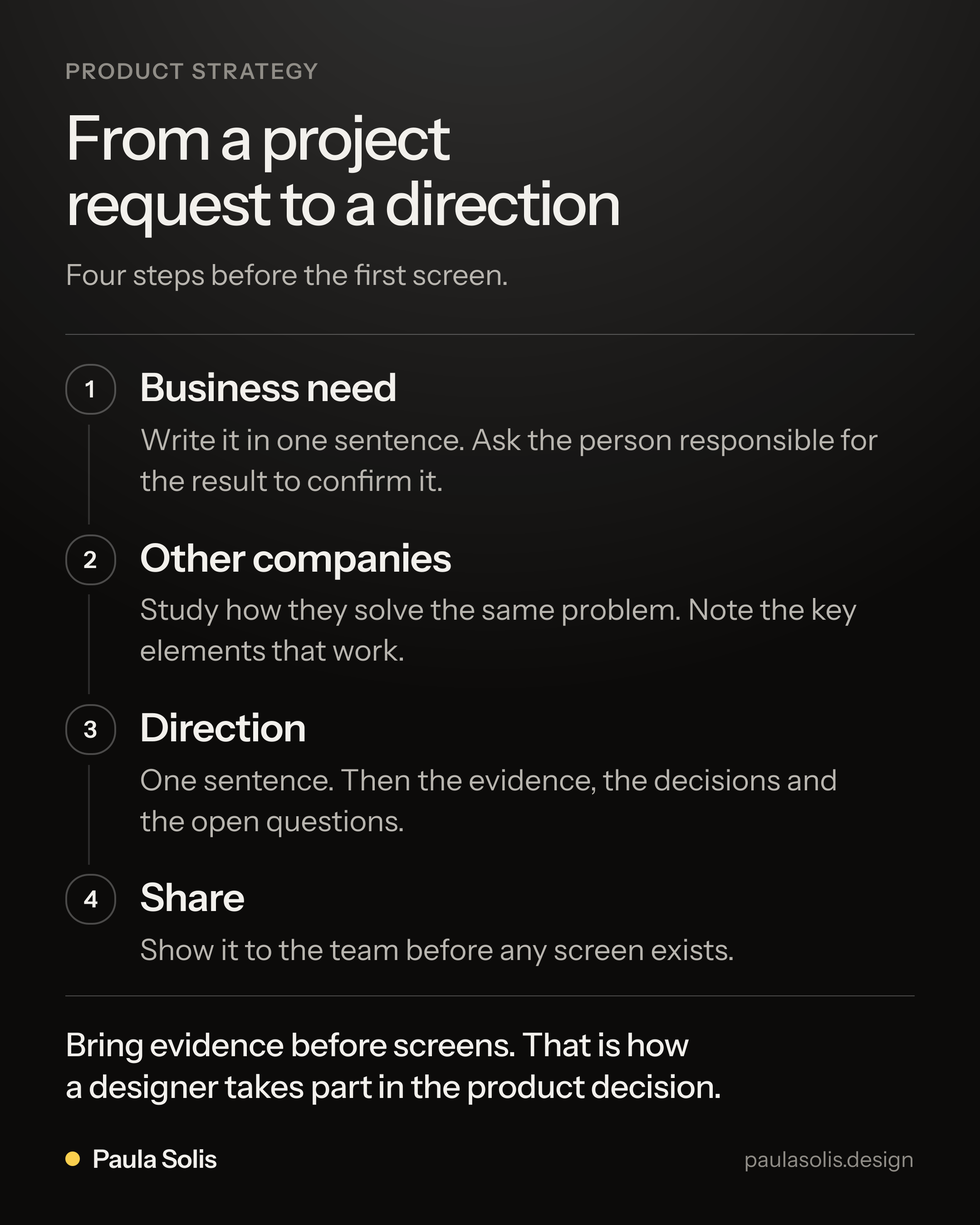
From a project request to a direction. Four steps before the first screen. 1. Business need: Write it in one sentence. Ask the person responsible for the result to confirm it. 2. Other companies: Study how they solve the same problem. Note the key elements that work. 3. Direction: One sentence. Then the evidence, the decisions and the open questions. 4. Share: Show it to the team before any screen exists. Bring evidence before screens. That is how a designer takes part in the product decision.
Questions and answers
What is the difference between product strategy and design strategy?
Product strategy says which problem the product solves, for whom, and why the company will earn from it. Design strategy says how the experience will make that true. In practice the two overlap, and a designer who understands both gives better guidance.
How much research does a designer need before the design starts?
Enough to answer two questions with evidence. What do other companies do, and what does the business need? Stop when new sources repeat what you already know.
Does a product designer need to understand the business model?
Yes. A design decision changes costs, sales or support work. A designer who knows how the company earns money can explain a decision in the words that the people with the budget use.