
A design system is a shared set of standards, design tokens, components and guidelines that product teams build with. In a large company it is the base that connects many products under one brand identity. Every team takes the same colours, type, words and patterns from it, so each product looks and works like the same brand.
I have 15+ years of experience in product design, design strategy and design systems. I guided the redesign of a design system. I did not build the components. I also worked in brand strategy. That work gave me a wider view of a product: the brand, its values and mission, the business and the people around it.
So I see a design system as a solid base. It connects all the products of a large company under one brand identity. This article explains what a design system holds, how it differs from brand guidelines and style guides, how it carries a brand into many products, and where one base reaches its limits.
What is a design system?
A design system is the set of shared standards that teams use to design and build products. Nielsen Norman Group, a UX research and consulting firm, defines it as “a complete set of standards intended to manage design at scale using reusable components and patterns.”
No definition is official. The publisher of Alla Kholmatova’s book “Design Systems” (2017) writes that the web community has no standard definition and uses the term in different ways. I add the brand to the definition, because in a large company the brand is the one thing that all the products share.
The parts of a design system rest on each other. Products use components. Components use design tokens. The Design Tokens Community Group describes a design token as the single source of truth to name and store a design decision, such as a colour or a space. The tokens carry the brand.
- Products The apps and websites that customers use
- Components and patterns Buttons, forms and full tasks, in design files and in code
- Design tokens Named decisions for colour, type and space
- Brand (highlighted) Values, mission and visual identity
What does a design system include?
Most design systems include foundations, documentation, design libraries, design tokens and code libraries. Fewer than half include the brand guidelines.
That is the result of the Design Systems Report 2026 by zeroheight. The survey asked 147 design system practitioners what their system includes. Each person could choose several answers.
Read the numbers with their limits. The sample is small, and the people chose to answer. zeroheight sells software for design system documentation. The 37% does not mean that the other companies have no brand guidelines. Many keep them in a separate brand book.
The table explains the main parts in plain words.
| Part | What it holds | Example |
|---|---|---|
| Foundations | The basic visual rules: colour, type, space, icons and grid | The type sizes for headings and for text |
| Design tokens | The foundations as named values that design tools and code can read | One name for the colour of the main button |
| Components | Reusable parts of the interface, in design files and in code | A button, a text field, a card |
| Patterns | Ways to solve a full task with components | A sign-in flow, a form that shows errors |
| Documentation | When and how to use each part | A page that says when to use a card |
Design system vs brand guidelines vs style guide
Brand guidelines say what the brand is. A style guide sets the rules for one area, such as visual design or content. A design system holds those rules and turns them into parts that teams build with.
Nielsen Norman Group describes a parent and its children. The design system is the parent. Style guides, pattern libraries and component libraries are its children. One of those children is the brand style guide, with colour palettes, typography, logos and imagery.
| Question | Brand guidelines | Style guide | Design system |
|---|---|---|---|
| What it answers | Who the brand is, and how it looks and speaks | The rules for one area, such as content or visual design | How every product is designed and built |
| Main readers | Marketing teams, agencies and designers | Designers and writers | Product designers, engineers and product managers |
| Form | A document or a site | A document or a site | Tokens, components, code and documentation |
| When it changes | With a new brand identity | When the rules of its area change | In regular releases, as the products change |
Brand guidelines often stop at the logo, the colours and the type. A brand is wider than that. It has values and a mission, and customers feel them in the words, in the order of a flow and in how a product treats an error. So I recommend that the design system carries the values too. For example, a bank whose brand promise is clarity can turn that value into two rules: plain words in every error message, and one main action on each screen.
How a design system carries one brand into many products
A design system carries the brand as decisions that every team uses. Each brand rule becomes a token or a component, so no team has to decide it again.
Public design systems describe this role in their own words. IBM calls its Carbon design system “the digital expression of the IBM brand”. The GOV.UK Design System helps teams make government services consistent with GOV.UK. When GOV.UK started to refresh its brand in June 2025, the design system team released several versions of its code, GOV.UK Frontend, so that service teams could update their services.
Nielsen Norman Group names the same benefit. A design system makes separate products and channels look like one brand, and a large rebrand can be managed through it.
The layer that turns brand rules into values for code is the design tokens. I explain it in what are design tokens. For public systems to study, see design system examples.
Why a large company needs one base, and what it costs
One base saves each team from the same decisions. Without a design system, Nielsen Norman Group writes, large organisations often design and code several versions of the same element.
The base has a cost. Nielsen Norman Group calls a design system a time-intensive activity that needs a dedicated team, and adds that it is never finished. In the zeroheight survey, 83% of respondents had a dedicated design system team, and 61% said they do not have enough people to meet their goals.
Does every team use the design system?
In most companies, no. Only 7% of the people in the zeroheight survey said every team uses their design system.
| Answer | Percentage of respondents |
|---|---|
| Fully adopted across all teams | 7% |
| Widely adopted by most teams | 31% |
| Moderately adopted by some teams | 38% |
| Minimally adopted by a few teams | 22% |
| Not adopted at all | 1% |
Source: zeroheight, Design Systems Report 2026. (opens in a new tab)
One base is a goal. How a company works decides the way to reach it. Spotify wrote in 2020 that its first central design system team became a bottleneck, because its product teams make their own decisions. At one point it counted 22 different design systems. Its answer was a family of design systems under one brand, which it called a “system of systems”.
So I recommend that you start from the products and the teams, before any component. I explain that method in design system redesign: start from real products. The brand stays one, even when the system has several parts.
How to start this week
Start with the brand and two products. You need no new tool for this.
- Write the brand on one page: its values, its mission and its visual rules for colour, type, logo and images.
- Turn each value into one rule that a team can apply on a screen. For example, “clarity” can become “one main action on each screen”.
- Choose two products and compare five shared decisions: the main button, the type sizes, the colour of errors, the words of one error message and the space between parts.
- Write down each difference, and ask the two teams why they decided that way.
- Take the list to the people who own the design system, and agree which decisions become tokens or components first.
Infographic
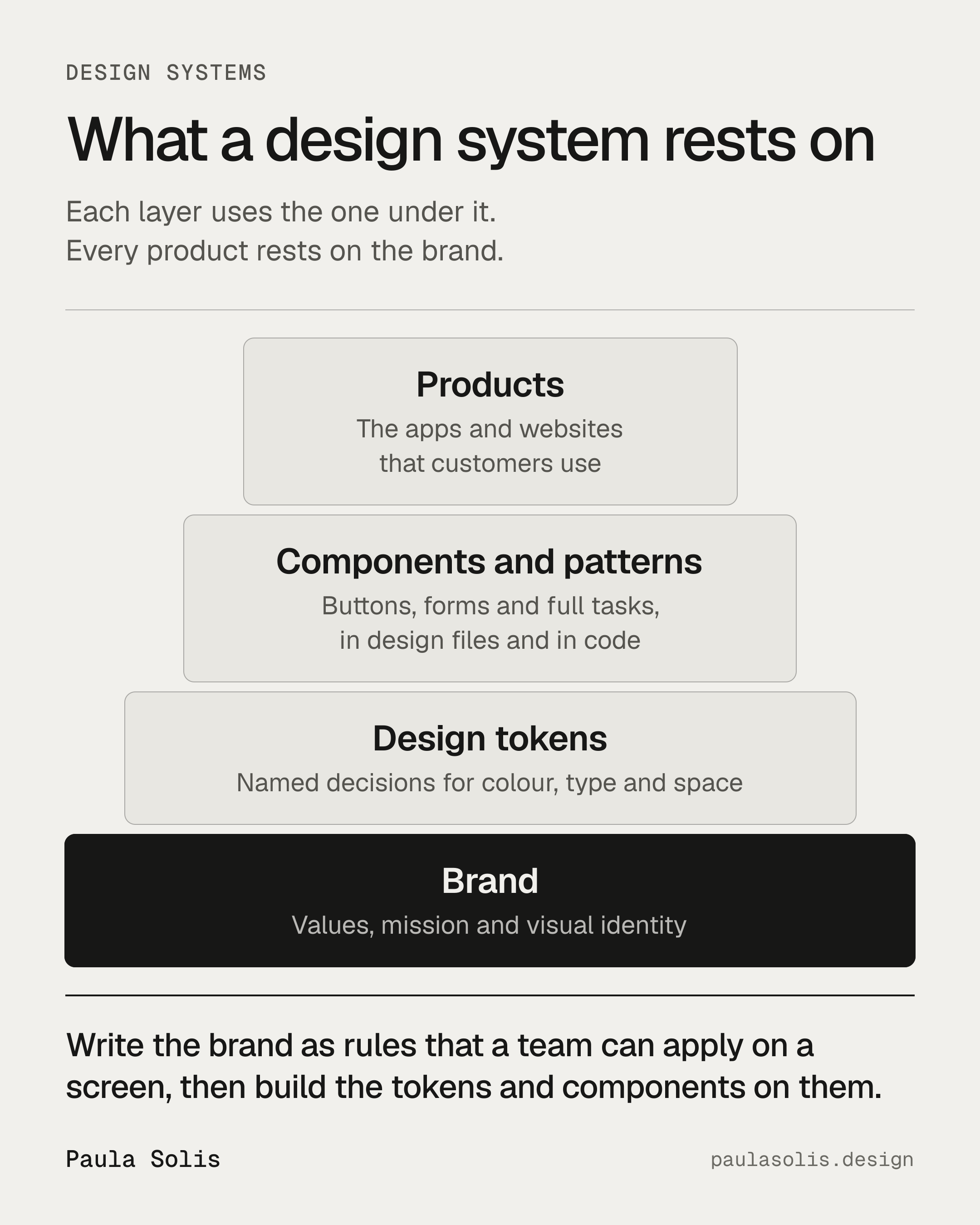
What a design system rests on. Each layer uses the one under it. Every product rests on the brand. Products: The apps and websites that customers use. Components and patterns: Buttons, forms and full tasks, in design files and in code. Design tokens: Named decisions for colour, type and space. Brand: Values, mission and visual identity. Write the brand as rules that a team can apply on a screen, then build the tokens and components on them.
Questions and answers
What is a design system?
A design system is a shared set of standards that teams use to design and build products. It holds design tokens, components, patterns and guidelines, with the code that matches them. Nielsen Norman Group calls it a complete set of standards to manage design at scale. In a large company, a design system connects many products under one brand.
What are components in a design system?
Components in a design system are the reusable parts of an interface, such as buttons, text fields, cards and menus. Each component exists in the design files and in code, with rules for when to use it. Teams build screens from the same components, so the same task looks and works the same way in every product.
What is the difference between a design system and brand guidelines?
Brand guidelines define the brand: the logo, the colours, the type, the images and the tone of voice. A design system turns those rules into parts that product teams build with, such as design tokens, components and patterns. Brand guidelines say what the brand is. A design system makes every screen follow it.
What is the difference between a design system and a style guide?
A style guide sets the rules for one area, such as visual design, content or the brand. A design system is larger. Nielsen Norman Group describes the design system as the parent, and style guides, pattern libraries and component libraries as its children. Together the children make up the design system.
What is an example of a design system?
Carbon, by IBM, is a well-known public example of a design system. IBM calls it the digital expression of the IBM brand. The GOV.UK Design System is another one. It helps teams across the UK government make their services consistent with GOV.UK. Both are public, so anyone can study how they are organised.
Sources (8)
- Design Systems 101 (opens in a new tab). Nielsen Norman Group, 2021.
- Design Systems vs. Style Guides (opens in a new tab). Nielsen Norman Group, 2024.
- Design Systems, by Alla Kholmatova (opens in a new tab). Smashing Magazine, 2017.
- Design Systems Report 2026 (opens in a new tab). zeroheight, 2026.
- About Carbon (opens in a new tab). IBM, 2026.
- GOV.UK Design System (opens in a new tab). Government Digital Service, 2026.
- Reimagining Design Systems at Spotify (opens in a new tab). Spotify Design, 2020.
- DTCG Glossary (opens in a new tab). Design Tokens Community Group, 2026.