
A design brief is a short document that a product team agrees on before the design starts. It names the problem the design must solve, the people who have it, what the business needs and how the team will measure success. This article is about briefs for digital products. A brief for a logo or a poster has other parts.
I am a Senior Product Designer, currently at Vodafone. When a project arrives, I research what other companies do and what the business needs. Then I guide where the product goes. I also worked in brand strategy and as an innovation and strategy consultant.
The mistake I see most in product design is a design that looks good and ignores the strategy of the product. The design brief is the earliest place to prevent it, because it ties the design to the business need before any screen exists. This article covers what a design brief is, how it differs from two similar documents, its parts, a one-page template, who signs it and the common mistakes.
What is a design brief?
A design brief is the agreement between the people who need a result and the people who design it. It describes the problem. The solution comes later, from the design work.
The idea is not new. The Design Council, the UK’s national charity for design, started to share its Double Diamond model of the design process in 2004. The model has four phases: Discover, Define, Develop and Deliver. In the Design Council’s history of the model, the Define phase ends with “a design brief which clearly defines the challenge based on these insights”. I explain the model in design thinking in practice.
Many of the pages that appear first for “design brief” describe a brief for graphic design: a logo, a poster or a website, with the files to deliver. A product design brief starts one step earlier, with the business goal and the customer problem. The screens and files are results of the work.
Design brief, creative brief and product requirements document
Three documents start design work. Each one answers a different question, and teams often confuse them.
| Document | Question it answers | Usually written by | When |
|---|---|---|---|
| Design brief | Which problem must the design solve, for whom, and why does the business need it? | The designer, with the product manager | Before the first screen |
| Creative brief | What must a campaign say, to whom, and with what result? | A marketing team, for an agency | Before a campaign |
| Product requirements document (PRD) | What will the product do, and how will it behave? | The product manager | When the team plans what to build |
Atlassian, which sells software for product teams, says a PRD “defines the purpose, features, and behavior of a product”. A creative brief is the marketing brief that a company gives to a creative agency. For a product, the design brief comes first. It names the problem and leaves the answer open. A PRD can grow from it once the team agrees on a direction.
What to put in a product design brief
Six parts fit on one page. Write them in this order, because each part depends on the one before it.
- Business goal What the company needs from the project, in one sentence, with the number the owner will watch.
- Customer problem Who has the problem, when it happens and why it matters to them. No solution.
- What other companies do How other companies solve the same problem, and the key elements that work.
- Scope and limits What is in and what is out. The fixed limits of time, budget, technology and brand.
- Measure of success How the team will know that the design worked, and when it will check.
- Owner The person who signs the brief and decides on the design. The dates of the reviews.
The business goal comes first for a reason. When the goal is on the page, people judge a screen by the goal and not by taste. I explain how to find the business need in product strategy for designers.
Here is the same template with an invented example. It describes no real product.
| Part | Invented example: a bike rental app |
|---|---|
| Business goal | More new customers rent a bike a second time within 30 days. |
| Customer problem | New customers are not sure where they may leave the bike, so the first ride ends with doubt. |
| What other companies do | Study how rental and transport apps show where a ride can end, before and during the ride. |
| Scope and limits | The first ride only. Payment stays as it is. Ready before the summer. |
| Measure of success | The percentage of new customers who ride again within 30 days, checked eight weeks after launch. |
| Owner | The product manager signs. The designer and the lead engineer review the draft. |
The customer problem names no screen and no feature. A map, a message or a new price could each solve it. The design work decides which one.
Who writes a design brief, and who signs it
The designer writes the design brief with the product manager. The person who owns the business result signs it. Engineers and researchers read the draft before it is signed.
The readers matter because the writer of a brief is not the best judge of how clear it is. A large survey of marketing briefs shows the gap.
Read the numbers with their limits. The BetterBriefs Project ran the survey with the research company Flood + Partners, and the IPA (Institute of Practitioners in Advertising) published the results in 2021. BetterBriefs sells training in brief writing. The answers are opinions, and the survey is about marketing and not about product teams.
The lesson still applies to a product team. On strategic direction, 78% of the writers were satisfied and 5% of the readers agreed. So ask the readers of your brief, the engineers, researchers and other designers, to mark every sentence they do not understand. Then ask the owner to sign. A signed brief is an agreement. When the project changes, the team uses it as the reference. It also makes it easier to explain a design decision to senior management later.
Common design brief mistakes
Watch for four mistakes. Two of them cost the most: a brief with no business goal, and a brief that names a solution in place of a problem.
No business goal. Without a goal, people judge the design by taste. A design can then look good and ignore the strategy of the product, which is the mistake I described at the start.
A solution in place of a problem. “Add a map to the first ride” is a solution. It closes the question before anyone has studied it. Nielsen Norman Group, a company that does UX research and sells UX training, says a problem statement should not contain a solution. The habit is common outside design too. In surveys of 106 senior executives from 91 companies, Thomas Wedell-Wedellsborg found that 85% agreed their organisations were bad at diagnosing problems. He published the result in Harvard Business Review in 2017. The sample is small, and the article does not say how the executives were chosen.
- Add a map to the first ride
- The design is decided before the work starts
- Success means the map exists
- New customers are not sure where they may leave the bike
- The team compares a map, a message and other answers
- Success means more customers ride a second time
Many problems in one brief. NN/g also warns against a list of unrelated problems. Write one brief for one problem. A second problem gets its own brief.
No owner. A brief that nobody signed is still a draft. When the project changes, nobody can say which version counts.
How to write your first design brief this week
Start with a project that begins soon, and keep the first brief to one page.
- Write the business goal in one sentence. Ask the owner of the result to confirm the number.
- Write the customer problem with no solution in it. If the sentence names a screen or a feature, rewrite it.
- Complete the other four parts of the template.
- Ask an engineer and a researcher to mark every sentence they do not understand.
- Ask the owner to sign, and save the brief where the whole team can find it.
Infographic
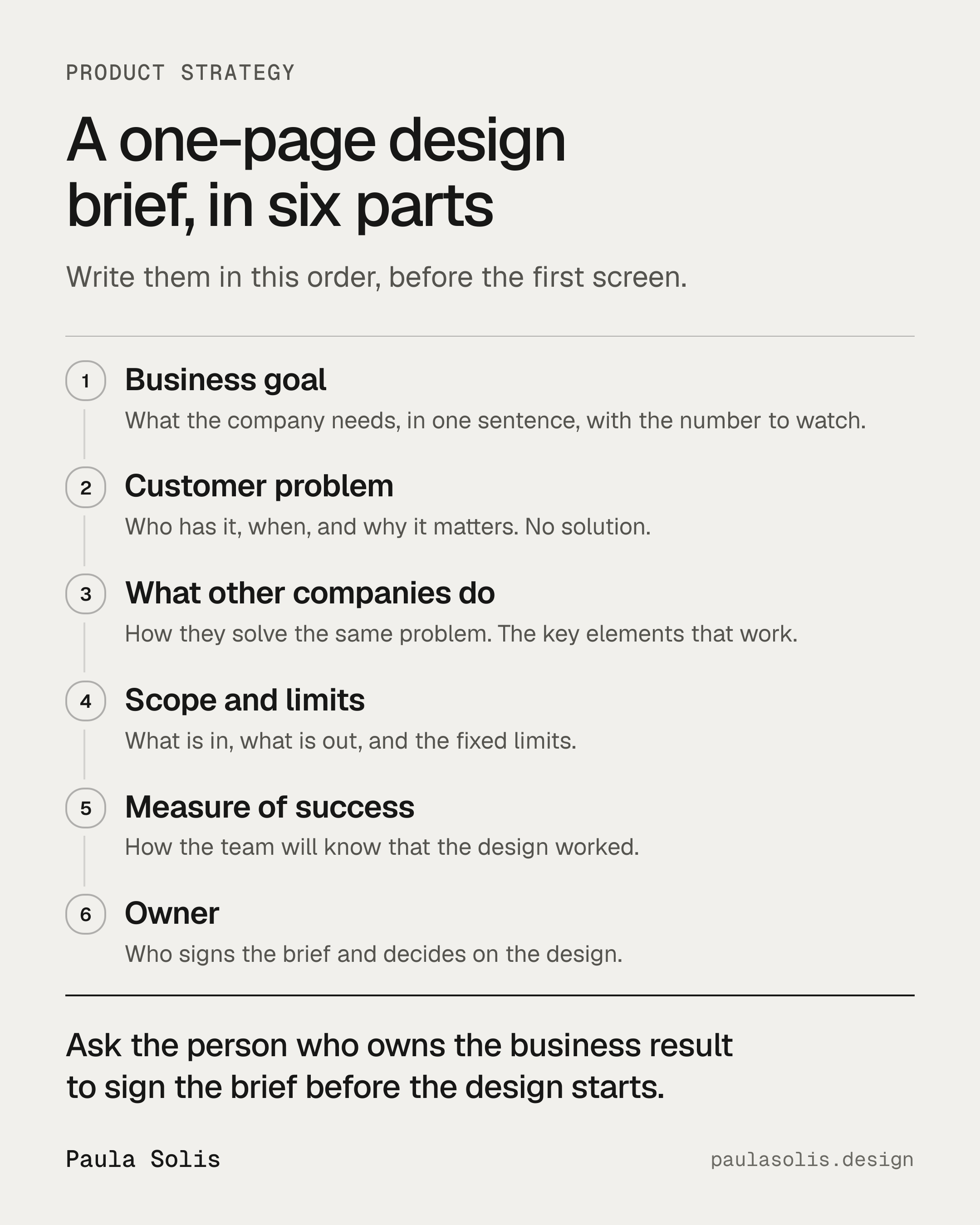
A one-page design brief, in six parts. Write them in this order, before the first screen. 1. Business goal: What the company needs, in one sentence, with the number to watch. 2. Customer problem: Who has it, when, and why it matters. No solution. 3. What other companies do: How they solve the same problem. The key elements that work. 4. Scope and limits: What is in, what is out, and the fixed limits. 5. Measure of success: How the team will know that the design worked. 6. Owner: Who signs the brief and decides on the design. Ask the person who owns the business result to sign the brief before the design starts.
Questions and answers
What is a design brief?
A design brief is a short document that a team agrees on before the design work starts. In a product team, the design brief names the problem the design must solve, the people who have it, what the business needs, the limits and how the team will measure success. A design brief describes the problem and leaves the solution to the design work.
What should a design brief include?
A product design brief has six parts on one page. The business goal, the customer problem, what other companies do, the scope and limits, the measure of success, and the owner who signs it. Write the business goal first, because the team judges every later design decision against it.
What is the difference between a design brief and a creative brief?
A creative brief starts a campaign or another piece of communication. A marketing team usually writes a creative brief for an agency. A design brief starts the design of a product or a service. A design brief describes a customer problem and a business goal that the product must meet.
Who writes the design brief in a product team?
In a product team, the designer writes the design brief together with the product manager. The person who owns the business result reads the design brief and signs it. Engineers and researchers read the draft first, because they see gaps that the writers do not see.
How long should a design brief be?
A design brief for a product team fits on one page. One page holds the six parts, and people read a short document. Keep research, data and screens in other documents, and link to them from the design brief.
Sources (5)
- History of the Double Diamond (opens in a new tab). Design Council.
- What is a Product Requirements Document (PRD)? (opens in a new tab). Atlassian.
- BetterBriefs: One third of marketing budgets could be wasted (opens in a new tab). IPA, 2021.
- Problem Statements in UX Discovery (opens in a new tab). Nielsen Norman Group, 2021.
- Are You Solving the Right Problems? (opens in a new tab). Harvard Business Review, 2017.