
To explain a design decision, give its design rationale: the problem, the goal, the options you compared, the choice, the evidence, the trade-off and what you will measure. Say the decision first, in the words of the business. Articulating design decisions this way gives senior management what it needs to act in a few minutes.
I am a Senior Product Designer, currently at Vodafone. I work with the lead designer and my manager on the key design decisions. In some meetings I present two or three slides to the management team. I am grateful to my managers at Vodafone. I learned from them how to present to senior management.
This article is the method I recommend: what a design rationale is, its seven parts, a template for a decision record, how to say it in two minutes and where to keep the record. It describes no real project and no real meeting.
What is a design rationale?
A design rationale is the reason behind a design decision: why you chose one option over the others, and what you gave up. A design decision is a choice between two or more ways to solve a design problem. For example, where the total sits on a payment screen, or when an app asks for a permission.
Software engineers have a written form for this: the decision record. The ADR GitHub organization, a group that shares practice on these records, says a decision record “captures a single AD and its rationale”, where AD means an architectural decision. It adds that the practice “can be extended to design and other decisions”.
So in UX work, design documentation is more than the screens. The screens show what the team decided. The rationale shows why. Michael Nygard, who proposed a format for these records in 2011, wrote: “One of the hardest things to track during the life of a project is the motivation behind certain decisions.” Without the reason, a new person can only accept the decision without question or change it without knowing what it protects.
A rationale also starts from the goal of the product, and not from the look. The mistake I see most is a design that is nice and ignores the strategy of the product. I explain the goal side in product strategy for designers.
The seven parts of a good design rationale
A good design rationale names the problem, the goal, the options, the choice, the evidence, the trade-off and what you will measure.
- Problem What does not work today, and for whom. One sentence.
- Goal The result the product needs, with a number when one exists.
- Options Two or three ways you considered, including no change.
- Choice The option you recommend, in one sentence.
- Evidence Research, a test, data or a known standard.
- Trade-off What the choice costs or gives up.
- Measure The number that will show if it works, and the date you will check it.
Tom Greever wrote the book Articulating Design Decisions (O’Reilly, 2015, second edition 2020). In an article from 2015, he lists three questions that a designer must answer: “What problem does it solve? How does it affect the user? Why is it better than the alternative?” The seven parts answer all three. The options and the trade-off answer the third, and Greever calls that answer the key to the support a designer needs.
I see design as a translation. It turns the ideas, opinions and numbers of product managers into solutions that can be built. A rationale is the same translation in the other direction, from the screen back to the business. Nielsen Norman Group says it in one line: “We speak users, whereas stakeholders speak business.”
A design decision record template
Write each design decision on one page, with the same fields every time. Then anyone can read it later, and two decisions are easy to compare.
The template adapts the format that Nygard proposed for software decisions: a title, the context, the decision, the status and the consequences. He wrote that the whole record “should be one or two pages long”. The last column is an invented example for an online shop. It describes no real product.
| Field | What to write | Invented example |
|---|---|---|
| Title | The decision as a short phrase | Ask for the phone number after sign-up |
| Status | Proposed, accepted or replaced | Proposed |
| Problem | What does not work today, and for whom | New customers stop at the phone field |
| Goal | The result the product needs | More new customers finish the sign-up |
| Options | Two or three ways, and no change | Keep the field, make it optional, or ask after sign-up |
| Choice | The option you recommend | Ask after sign-up, with the first order |
| Evidence | What supports the choice | Usability tests, and the same pattern in other shops |
| Trade-off | What the choice costs | Fewer phone numbers on the first day |
| Measure | The number, and the date to check it | The percentage of finished sign-ups, after four weeks |
| Who and when | Who decided, and the date | The design lead and the product manager, with the date |
Nygard gives each record a status. A decision is “proposed” until people agree, and “accepted” after. When a later decision reverses it, keep the old record and mark it as replaced. Nygard’s word is “superseded”. The history stays readable.
How to explain a design decision to senior management in two minutes
Say the decision and the business goal first. Then give the options, the evidence and the trade-off. End with what you need from the people in the room.
This order follows the Minto Pyramid Principle. Barbara Minto’s site says that your thinking is easy to grasp “if you present the ideas organized as a pyramid under a single point”. The single point goes first. Nancy Duarte gives the reason for senior executives in Harvard Business Review (2012): they “won’t sit still for a long presentation with a big reveal at the end”.
- Decision and goal (highlighted) 0 to 20 seconds
- Problem and options 20 to 50 seconds
- Evidence 50 to 75 seconds
- Trade-off and measure 75 to 100 seconds
- What you need from them 100 to 120 seconds
Many managers already feel that their time for decisions is not well used. In a McKinsey survey of 1,259 people in February 2018, 61% said most of their decision-making time is used ineffectively. McKinsey is a management consulting firm. The answers are opinions about time, not measured time.
The same decision needs different words for different people.
- Start with the screens
- Talk about layout, patterns and the design system
- Show each option in detail
- Ask for comments
- Start with the decision and the goal
- Talk about customers, money, time and risk
- Show the choice and one alternative
- Ask for a decision, by a date
With designers, the decision is still open. That meeting is a critique, and I explain it in how to give design feedback.
With two or three slides, I recommend one decision per slide. Write the title of each slide as a full sentence that states the point. In a 2013 experiment, Joanna Garner and Michael Alley showed one technical talk to 110 engineering students. The slides with a sentence as the title and visual evidence under it were understood better than slides with a topic title and bullet points. The students learned a topic and made no decision, and one of the authors teaches this way of making slides.
Replace design words with business words. Say “what people see first”, not “visual hierarchy”. Say “fewer people stop”, not “less friction”.
One large company uses no slides at all. In his 2017 letter to shareholders, published in April 2018, Jeff Bezos wrote: “We don’t do PowerPoint (or any other slide-oriented) presentations at Amazon.” Teams there write six-page memos, which people read in silence at the start of the meeting. Both forms need the same rationale. The written record is the long form, and the two minutes are the short form. To ask for budget for a new idea, the method is different. I explain it in how to pitch a design idea.
Where to keep design decisions
Keep the record where the team already works, and link it from the design file and from the slide.
| Place | Good for | Watch for |
|---|---|---|
| A page next to the screens in the design file | Designers who open the file | It is lost when the file is replaced |
| A decision log in the team wiki | Product managers, engineers and new people | It needs one owner |
| A folder in the code repository, as Nygard proposes for software | Engineers | Designers and managers seldom open it |
| A public design history | Teams that work in the open | Only public facts, and approval first |
The UK Department for Education uses the last form. Its site says that “a design history is a public way to document changes to a service”, and that it tells “what design changes have to be made and why”. A team needs the approval of a deputy director before it starts one. In most companies the record stays private. Write it so that a person who joins next year understands it.
How to start this week
- Choose one design decision from this month that people still ask about.
- Write it in the template: problem, goal, options, choice, evidence, trade-off and measure.
- Read it aloud and cut it to two minutes. Start with the decision.
- Ask a product manager to read it and mark what is not clear.
- Save the record where the team works, and link it from the design file.
Infographic
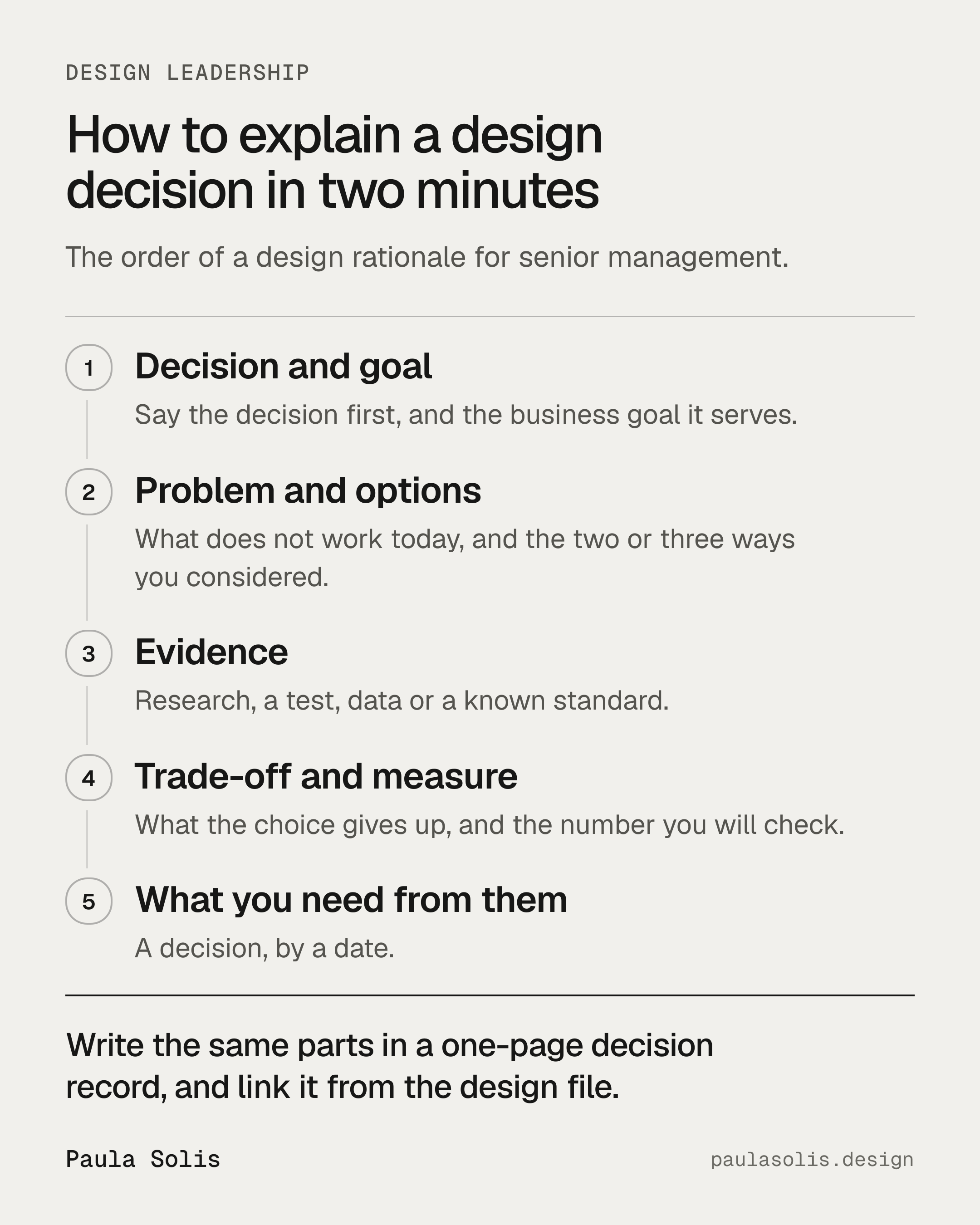
How to explain a design decision in two minutes. The order of a design rationale for senior management. 1. Decision and goal: Say the decision first, and the business goal it serves. 2. Problem and options: What does not work today, and the two or three ways you considered. 3. Evidence: Research, a test, data or a known standard. 4. Trade-off and measure: What the choice gives up, and the number you will check. 5. What you need from them: A decision, by a date. Write the same parts in a one-page decision record, and link it from the design file.
Questions and answers
What is a design rationale?
A design rationale is the reason behind a design decision. It names the problem, the goal, the options that were compared, why one option won, the evidence and what the choice gives up. Software teams write it down as a decision record, which captures one decision and its rationale.
What is a design decision?
A design decision is a choice between two or more ways to solve a design problem. Examples are where the total appears on a payment screen, how many steps a sign-up has, or when an app asks for a permission. A design decision has a reason, a cost and a result that a team can measure.
Can you give me some examples of design decisions?
Examples of design decisions are to ask for a phone number after sign-up and not before, to show the price on the first screen, to use a component of the design system and not a new one, and to ask for the location only when a feature needs it. Each one needs a reason, a trade-off and a measure.
How do you articulate design decisions to stakeholders?
To articulate design decisions to stakeholders, start with the decision and the business goal. Then give the options, the evidence and the trade-off, and say what you will measure. Tom Greever, author of the book Articulating Design Decisions, lists three questions to answer: what problem it solves, how it affects the user, and why it is better than the alternative.
What should design documentation include?
In UX work, design documentation should include the decisions and their reasons, not only the screens. For each design decision, write the problem, the goal, the options, the choice, the evidence, the trade-off, the measure, the date and who decided. Keep the documentation where the team works, and mark a decision as replaced when it changes.
Sources (11)
- Great Designers are Great Communicators (opens in a new tab). UX Booth, copy in the Internet Archive, 2015.
- Articulating Design Decisions, 2nd Edition (opens in a new tab). O'Reilly Media, 2020.
- How to Sell UX: Translating UX to Business Value (opens in a new tab). Nielsen Norman Group, 2021.
- Documenting Architecture Decisions (opens in a new tab). Cognitect, 2011.
- Architectural Decision Records (ADRs) (opens in a new tab). ADR GitHub organization.
- Minto Pyramid Principle (opens in a new tab). Minto Books International.
- How to Present to Senior Executives (opens in a new tab). Harvard Business Review, 2012.
- Decision making in the age of urgency (opens in a new tab). McKinsey & Company, 2019.
- How the Design of Presentation Slides Affects Audience Comprehension: A Case for the Assertion–Evidence Approach (opens in a new tab). International Journal of Engineering Education, 2013.
- 2017 Letter to Shareholders (opens in a new tab). Amazon, 2018.
- Start a design history (opens in a new tab). Department for Education, UK.