
A design critique is a conversation that checks a design against its goal, so that the design improves. To give design feedback in a critique, start with what works and say why. Tie each comment to the goal. Suggest a direction, and leave the change to the designer. Show a reference from another product for the level you expect.
I mentor designers and review their work. I design the key flows and screens of a product and guide the designers who build on them. We review the work in calls, every week at the start and every two weeks later. I am grateful to my managers at Vodafone. I learned from them how to give feedback and how to run meetings and workshops.
This article is the method I recommend for any product team: how to run a design critique, my three rules for comments, and how to receive feedback, also remotely. It describes no real project and no real team.
What is a design critique?
A design critique is an analysis of a design against its goal, done as a conversation. Nielsen Norman Group, a UX research and training company, defines it as “analyzing a design, and giving feedback on whether it meets its objectives” (Sarah Gibbons, 2016). The person who shows the design is the presenter. The other people in the session comment on it.
Not every comment is critique. In the book Discussing Design (2015), Adam Connor and Aaron Irizarry describe three forms of feedback: reaction, direction and critique. Only critique says if the design meets its goal.
| Form of feedback | What it sounds like | What the designer learns |
|---|---|---|
| Reaction | “I love it.” “I do not like this colour.” | How one person feels |
| Direction | “Make the button bigger.” | What one person would do |
| Critique | “The goal is a fast payment. The pay button is at the end of a long page, so people may not see it.” | If the design meets its goal, and why |
The authors give good critique three parts. It names one part of the design. It relates that part to a goal or a best practice. It says how and why the part helps or does not help the goal. Write every comment in these three parts.
Design critique vs design review vs approval
A critique improves work in progress. A design review checks a design against fixed criteria. An approval decides if the work moves on. Keep the three apart, because each one asks a different question.
Nielsen Norman Group describes design reviews as “evaluations of a design based on a set of heuristics”, done by a usability expert or in a meeting at the end of the work, “in order to gain approval and move forward”. Heuristics are general rules of usability. The table splits the review and the approval, because a team often needs both.
| Meeting | Its question | When | Result |
|---|---|---|---|
| Design critique | Does this design meet its goal? | Early, and on a fixed rhythm | Points for the designer to explore |
| Design review | Does the design follow the rules of usability, accessibility and the design system? | Before the work goes to engineers | Issues to fix, each with its rule |
| Approval | Does the work move on? | At the end of a phase | Yes, no, or yes with changes |
In an approval, the designer explains decisions to the people who own the result. I write about that skill in how to explain a design decision.
How to prepare and run a design critique
Agree on the goal before the session, keep it short, and give each person a role. Nielsen Norman Group names a facilitator, who guides the session, and a recorder, who takes notes where everyone can see them. As a start, it suggests 30 minutes a week.
- Share the goal The designer writes the goal, the user and the stage of the work. Send it a day before.
- Present A few minutes on the goal and the flow. End with the question you want answered.
- Comment Each comment names a part, the goal and why. The facilitator turns opinions into questions about the goal.
- Close The recorder reads the points back. The designer says which ones to explore.
- Start the next session Begin with what changed since the last one.
The rhythm matters more than the length. Early work changes fast, so review it more often at the start, and less often once the direction is clear.
Nielsen Norman Group lists five common problems of a critique. Two of them are the first ones to prevent: no agreement on the goal before the session, and sessions that are too long.
Three rules for design feedback that helps
My three rules are: start with what works, suggest and do not redo the design, and show a reference from another product. Each rule has a limit in the research, and the limit says how to use it.
Start with what works. Name the part that works, why it works, and the effort you see in it. Praise alone gives little. In a 1996 meta-analysis, a study that combines many earlier studies, Avraham Kluger and Angelo DeNisi compared feedback against groups that got no feedback. Across 607 measured effects, feedback improved performance on average, and in more than a third of them performance went down. Feedback that held praise had a smaller average effect on performance than feedback without praise. Their explanation is that praise moves attention from the task to the person.
So the praise must carry information about the work. “The effort you see” means what the effort produced. For example: “You tested three versions of the form. The third one asks for less, and it keeps the price in view.”
Suggest, do not redo. Describe the problem and the goal. Suggest a direction. Let the designer choose the change. The same meta-analysis found a larger effect when feedback gave the correct solution (0.43 against 0.25). In those tasks one correct answer existed. A design problem has many good answers, and the designer knows the details best. Google gives the same advice to its code reviewers: the author fixes the work, not the reviewer, because “the developer is closer to the code than the reviewer is”. The guide also allows direct instructions in some cases. When the answer is a fixed rule, such as a rule of accessibility, say it directly.
- Move the total to the top.
- Make the button green.
- Copy the checkout of that app.
- The designer gets a list of tasks.
- The goal is that people check the total before they pay.
- The total sits at the bottom in small type, so people may miss it.
- That app shows the total next to the pay button. How could ours show it?
- The designer keeps the choice.
Google’s guide also asks reviewers to label each comment, so the author can tell a required change from a suggestion. Do the same: mark each comment as a must or an idea.
This rule is also how I see leading. A lead gives guidance on the design and on the team, adapted to each person. No micromanagement. Designers have freedom to propose, and the lead listens.
Show a reference from another product. A reference shows the level you expect better than an adjective. In a 2012 experiment with 81 people, Chinmay Kulkarni, Steven Dow and Scott Klemmer found that examples made people copy more features of the examples, whenever they saw them. Examples shown before the work raised the creativity ratings. Examples shown later did not. The people drew aliens in two sessions of 7 minutes, so the result is a hint for design work and not proof.
So name the quality to match, not the screen to copy. Show two or three references, not one. When you can, share references at the start, with the brief. I explain the brief in how to write a design brief.
How to receive design feedback
Say what kind of feedback you need, listen to the end, and ask for the goal behind each comment.
- Before you show the work, say its stage and the question you want answered. A sketch needs comments on the flow, not on the colours.
- Write every comment down. You do not need to answer each one in the session.
- When a comment is a reaction or a direction, ask one question: “Which goal does that help?” The answer turns it into critique.
- Keep the work and yourself apart. Nielsen Norman Group lists taking feedback personally as one of the common problems of a critique.
- After the session, decide what to change. For each comment you do not follow, write one sentence on why.
How to run a design critique remotely
Share the file and the goal before the call. Collect written comments first, and use the call for the few comments that need a conversation.
- Use one shared file. Each comment sits on the part of the screen it names.
- Write the notes during the call, on one shared page.
- Ask for comments in writing before the call, so people in other time zones can take part. I write about time zones in working from Madrid with a team in London.
- A written comment has no tone of voice. Before you post one, read it again. Check that it names a part, the goal and why.
How to start this week
- Write the goal of one design in one sentence. Share it with the designer before the next review.
- Book 30 minutes for a critique, with a presenter, a facilitator and a recorder.
- Write each comment in three parts: the part of the design, the goal and why. Start with what works.
- Mark each comment as a must or an idea.
- Bring two references from other products, and say which quality to match.
Infographic
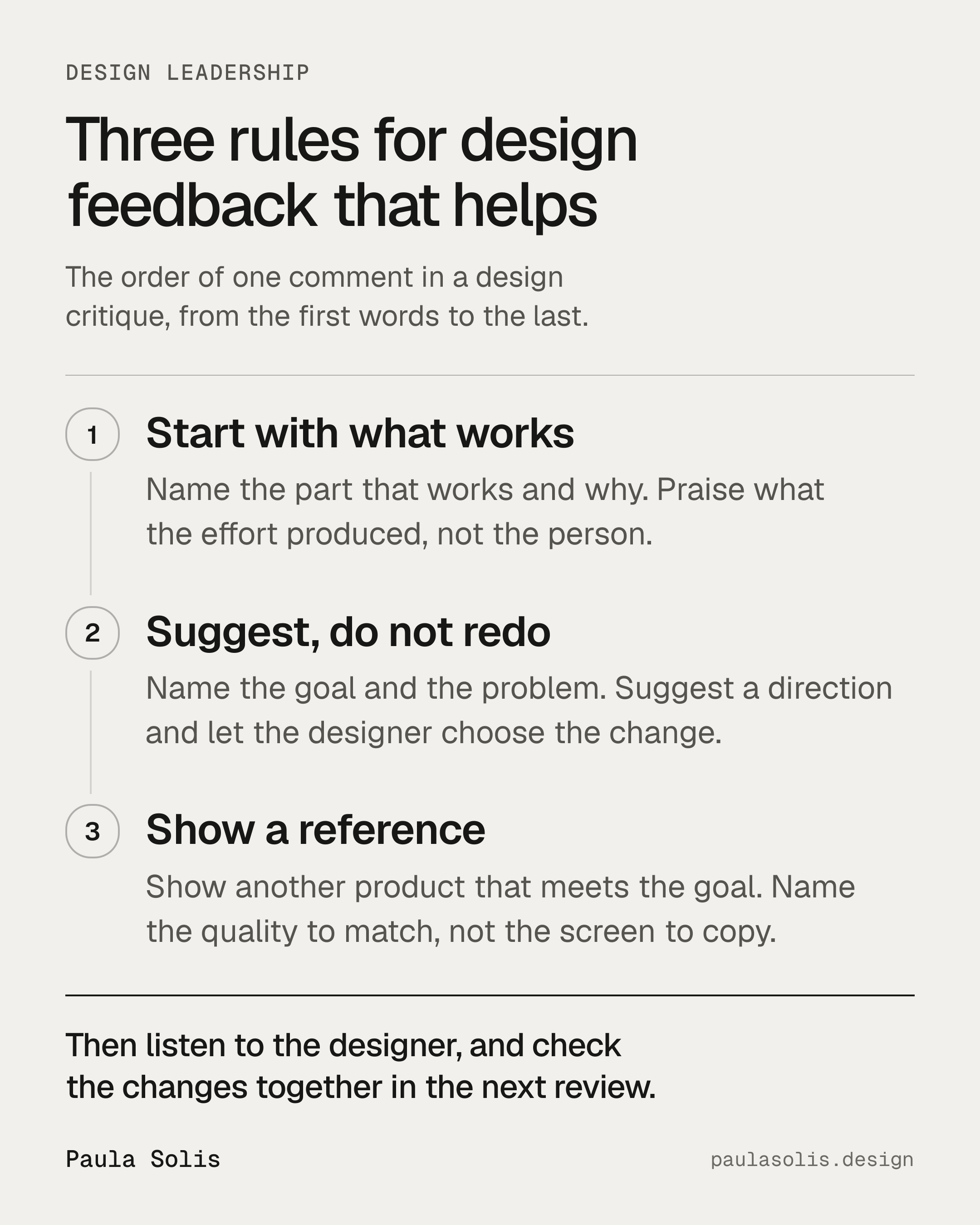
Three rules for design feedback that helps. The order of one comment in a design critique, from the first words to the last. 1. Start with what works: Name the part that works and why. Praise what the effort produced, not the person. 2. Suggest, do not redo: Name the goal and the problem. Suggest a direction and let the designer choose the change. 3. Show a reference: Show another product that meets the goal. Name the quality to match, not the screen to copy. Then listen to the designer, and check the changes together in the next review.
Questions and answers
What is a design critique?
A design critique is a conversation in which a team checks a design against its goal, to improve the design. Nielsen Norman Group defines it as analyzing a design and giving feedback on whether it meets its objectives. A design critique looks at work in progress. It is not a vote and not an approval.
What is the difference between a design critique and a design review?
A design critique improves work in progress through a conversation about its goal. A design review checks a design against a set of criteria, such as usability rules or the rules of a design system. Nielsen Norman Group adds that a design review can be a meeting at the end of the work, held to get approval.
What are examples of good design feedback?
Good design feedback names one part of the design, the goal, and why the part helps or does not help that goal. For example: the goal is that people check the total before they pay, and the total sits at the bottom in small type, so people may miss it. The designer then chooses the change.
Does the feedback sandwich work?
The feedback sandwich puts a correction between two positive comments. The evidence for the feedback sandwich is thin. In a 2013 study with medical students, Parkes and others found that students believed sandwich feedback improved their later work, and found no evidence that it did. Praise that names a part of the work and why it works gives more information.
How do you give design feedback without redoing the design?
To give design feedback without redoing the design, describe the problem and the goal, and do not draw the solution. Suggest a direction, and show a reference from another product when it makes the level clear. Then let the designer choose the change. Google's guide for its code reviewers gives the same advice for code.
Sources (6)
- Design Critiques: Encourage a Positive Culture to Improve Products (opens in a new tab). Nielsen Norman Group, 2016.
- Discussing Design (opens in a new tab). O'Reilly Media, 2015.
- The Effects of Feedback Interventions on Performance: A Historical Review, a Meta-Analysis, and a Preliminary Feedback Intervention Theory (opens in a new tab). Psychological Bulletin, American Psychological Association, 1996.
- How to write code review comments (opens in a new tab). Google Engineering Practices Documentation, 2022.
- Early and Repeated Exposure to Examples Improves Creative Work (opens in a new tab). Proceedings of the Cognitive Science Society, Stanford HCI Group, 2012.
- Feedback sandwiches affect perceptions but not performance (opens in a new tab). Advances in Health Sciences Education, record in PubMed, 2013.