
Design tokens are named design decisions, such as a colour, a font size or a space, stored as a name and a value. Designers and engineers use the name, and tools turn it into code for each platform. When a decision changes, a team changes the value once, and every product that uses the token changes with it.
I guided the redesign of a design system. I did not build the components. One goal of the redesign was a system that fits development with AI tools. Design tokens matter for any system with that goal, because a name tells a person and an AI tool what a value is for.
For the wider picture of a design system, read what is a design system.
What is a design token?
A design token is a design decision with a name. The Design Tokens Community Group, a W3C community group that writes a shared file format for tokens, defines a token as “information associated with a human readable name, at minimum a name/value pair.”
The value can be a colour, a size, a font, a time or another token. A token whose value is another token is called an alias. The table shows real tokens from public design systems.
| Token name | Value | Design system | What it decides |
|---|---|---|---|
md.ref.palette.secondary90 | #E8DEF8 | Material Design 3 | One colour of the palette |
spacing-100 | 8px | Adobe Spectrum | One step of the space scale |
container-padding-medium | spacing-300, another token | Adobe Spectrum | The space inside a container |
accent-content-color-default | accent-color-900, another token | Adobe Spectrum | The colour of text that must stand out |
color.icon.success | Changes with the light or dark theme | Atlassian | The colour of an icon that means success |
The Design Tokens Community Group writes that the name design tokens comes from the Salesforce design system team. In 2016, Nathan Curtis of the consultancy EightShapes described the step from code variables to tokens. A variable lists the options. A token records which option to use, and where.
Why limit the options? The U.S. Web Design System gives a reason. The RGB colour space has over 16 million colours, and that much choice slows design work. So its tokens are a short list. For line length, it allows seven.
What are the types of design tokens?
Most design systems use three tiers of design tokens. Primitive tokens hold the raw values. Semantic tokens give a value a purpose. Component tokens apply a decision to one part of one component.
- Component tokens One part of one component, such as the background of a button
- Semantic tokens (highlighted) The purpose of a value, such as the colour of text that means success
- Primitive tokens The raw values, such as every colour and space the brand allows
Each design system gives the tiers its own names.
| Tier | Material Design 3 | Adobe Spectrum | What the tier holds |
|---|---|---|---|
| Primitive | Reference tokens, prefix ref | Primitive or global tokens | All the values the design language allows |
| Semantic | System tokens, prefix sys | Semantic tokens | The purpose of a value in the interface |
| Component | Component tokens, prefix comp | Component-specific tokens | The decisions for one part of one component |
Material Design 3 says that themes are applied in the system tier: a system token can point to a different reference token in a light or a dark theme. Adobe Spectrum writes that semantic tokens are the main way teams use its tokens.
How common is each tier? The Design Systems Report 2026 by zeroheight asked 147 design system practitioners. 86% said their design system includes design tokens. Most had a primitive and a semantic layer, and about half had a component layer.
Read the numbers with their limits. The sample is small, and the people chose to answer. zeroheight sells software for design system documentation. In the same survey, 60% said they have no token automation, so many teams copy tokens by hand. For full systems that use tokens, see design system examples.
How design tokens carry one brand into every product
Products use semantic tokens, and semantic tokens point to primitive tokens. To change the brand, a team changes values in one place, and every product that uses the names follows.
Atlassian describes this benefit: as its visual language changes, “changes can be made once across the system and apps.” Material Design 3 writes that style updates then reach an entire product or a suite of products. In the zeroheight survey, 63% of respondents use tokens to theme different brands or products. 76% use them for visual modes such as light, dark and high contrast.
Tokens also carry rules that every screen must keep. Dynatrace writes that its colour tokens for text and icons have a contrast ratio of at least 4.5:1 to their background. So a team that uses those tokens starts from colours that meet that rule.
I also worked in brand strategy, so I see this tier as the place where the brand meets the screen. A name such as color.text.error says what a colour means. With a new brand identity the value changes, and the meaning stays.
Is there a W3C standard for design tokens?
No W3C standard for design tokens exists. The Design Tokens Community Group, a W3C community group, published the first stable version of its format, 2025.10, on 28 October 2025.
The specification states its status: it “is not a W3C Standard nor is it on the W3C Standards Track.” It is a Final Community Group Report. It describes a file format to exchange tokens between tools, written in JSON, a common text format for data. It has three modules: Format, Color and Resolver. The Resolver module handles tokens in several contexts, such as a light and a dark theme. On 5 November 2026, the group’s list of technical reports still shows 2025.10 as its only stable version.
- 2021 First Editors' Draft Published on 23 September 2021.
- 2022 Second Editors' Draft Published on 14 June 2022.
- 2025 Third Editors' Draft Published on 21 July 2025.
- 2025 First stable version, 2025.10 (highlighted) Published on 28 October 2025. Its modules are Format, Color and Resolver.
Source: Design Tokens Community Group, Technical Reports. (opens in a new tab)
Its own list of adopters and participants includes Adobe, Figma, Penpot and Sketch. A shared format lets a team move its tokens from one tool to another.
Why design tokens matter for AI coding tools
An AI coding tool that sees only a picture of a design has to guess the values. With token names, it can use the same decisions as the rest of the product.
From a screenshot, Figma writes, an AI tool “picks a shade of blue that’s close to your brand color but doesn’t know it’s mapped to a specific token.” Figma also notes that several tokens can share the same red value, so the colour alone does not say which token to use. Through its MCP server, Figma gives the AI tool the name of the token. MCP is a way to connect an AI tool to other tools, and I explain it in MCP for designers. Figma sells this product and published no test of the claim.
I use Claude, Claude Code, Cursor, Figma AI and ChatGPT. I give each tool the context of the job, and I check every answer it gives me. With design tokens my rule is this: give the tool the token names and what each one is for, then check that the new code uses the names. A raw colour code in new code is a sign that the tool guessed.
How to name design tokens
Name a token for its purpose, and go from the general part to the specific part.
Atlassian splits a token name into three parts. The table reads its example, color.icon.success.
| Part of the name | What it says | In color.icon.success |
|---|---|---|
| Foundation | The kind of style, such as colour, elevation or space | color |
| Property | The part of the interface it styles, such as a border or a background | icon |
| Modifier | The role, the emphasis or the state | success |
Material Design 3 uses the same order: the system name first, then the tier, then the role. Atlassian also gives a warning. Do not use a token only because its colour looks right, because that “can break the experience in other themes.”
Three rules I recommend:
- Use the words of the interface: text, background, border, icon.
- Name the meaning, such as success, error or brand. A colour word such as green stops being true when the brand changes.
- Make a new token when a decision repeats. Nathan Curtis suggests three uses as the point where a choice becomes a token.
How to start this week
- Take two products and list the colours, type sizes and spaces they use. Count the different values.
- Group those values into a short set of primitive tokens.
- Name the semantic tokens for purposes: text, background, border, success, error.
- Ask the engineers where the code uses raw values, and replace the most used ones first.
- Give your AI coding tool the token names with one line about each, and check that its code uses them.
Infographic
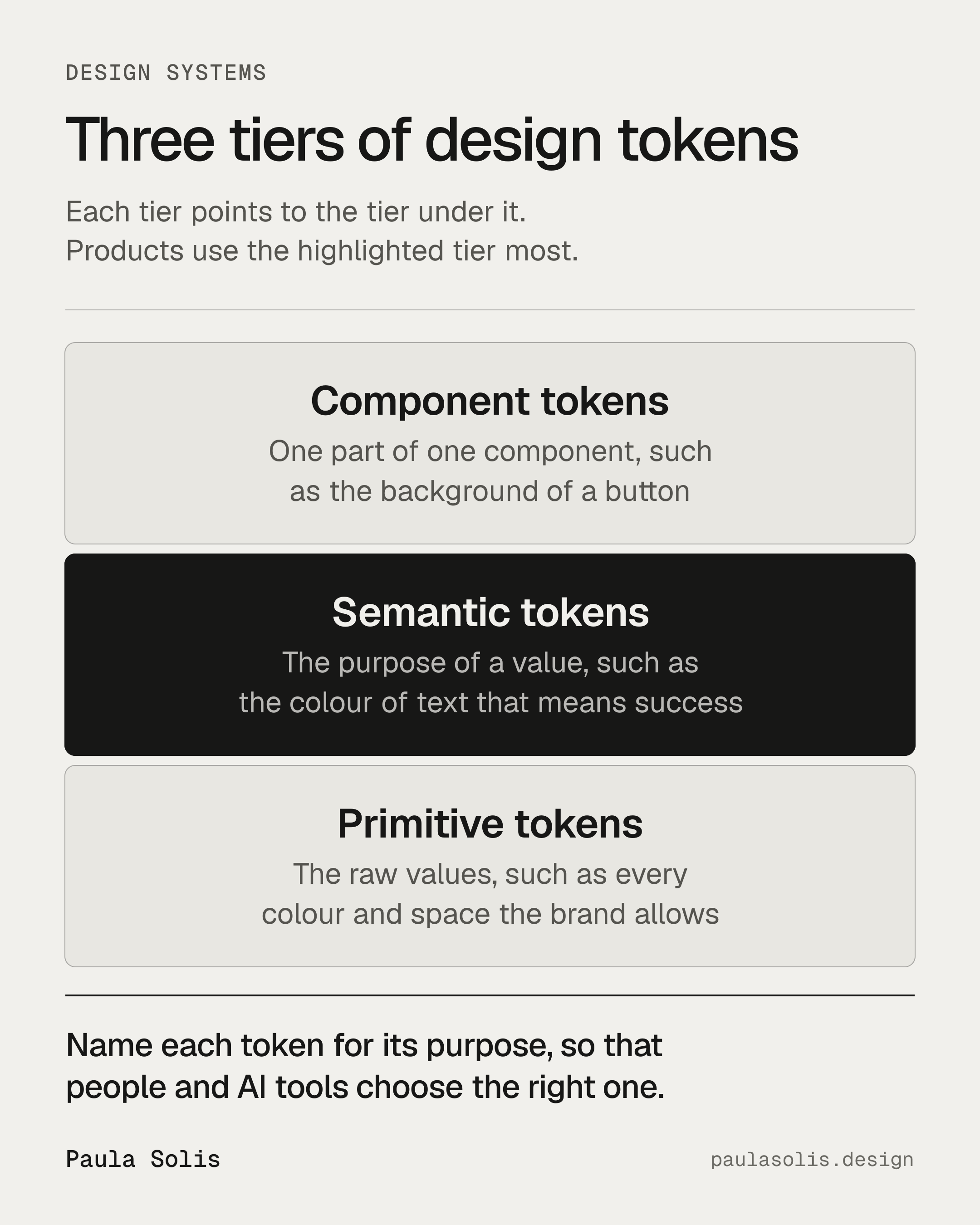
Three tiers of design tokens. Each tier points to the tier under it. Products use the highlighted tier most. Component tokens: One part of one component, such as the background of a button. Semantic tokens: The purpose of a value, such as the colour of text that means success. Primitive tokens: The raw values, such as every colour and space the brand allows. Name each token for its purpose, so that people and AI tools choose the right one.
Questions and answers
What are design tokens?
Design tokens are named design decisions, such as a colour, a font size, a space or a motion. Each token has a name and a value, for example a name for the colour of text that means success. Designers, engineers and tools use the name. When the value changes, every product that uses the token changes with it.
Can you give me an example of a design token?
In Material Design 3, the design token md.ref.palette.secondary90 has the value
What are the types of design tokens?
Most design systems use three tiers of design tokens. Primitive tokens, also called reference or global tokens, hold the raw values. Semantic tokens, also called system tokens, give a value a purpose, such as the colour of body text. Component tokens apply a decision to one part of one component, such as the background of a button.
Is there a W3C standard for design tokens?
No W3C standard for design tokens exists. The Design Tokens Community Group, a W3C community group, published the first stable version of its format, 2025.10, on 28 October 2025. The group writes that its format is not a W3C Standard and is not on the W3C Standards Track. Figma, Penpot and Sketch are on its list of adopters and participants.
Why do design tokens matter for AI coding tools?
An AI coding tool that sees only a picture of a design has to guess the values. It can pick a colour close to the brand colour and miss the token behind it. Figma says its MCP server gives the tool the name of the token. Figma published no test of this, so check that the code uses the token names.
Sources (12)
- Design Tokens Format Module 2025.10 (opens in a new tab). Design Tokens Community Group, 2025.
- Design Tokens Technical Reports 2025.10 (opens in a new tab). Design Tokens Community Group, 2025.
- Technical Reports (opens in a new tab). Design Tokens Community Group, 2026.
- Design tokens (opens in a new tab). Material Design 3, Google, 2026.
- Design tokens (opens in a new tab). Adobe Spectrum, 2026.
- Overview - Design tokens (opens in a new tab). Atlassian Design, 2026.
- Design tokens (opens in a new tab). U.S. Web Design System, 2023.
- Design token basics (opens in a new tab). Dynatrace Developer, 2026.
- Tokens in Design Systems (opens in a new tab). Nathan Curtis, EightShapes, 2016.
- Design Systems Report 2026 (opens in a new tab). zeroheight, 2026.
- The TL;DR on MCP: Why context matters and how to put it to work (opens in a new tab). Figma, 2026.
- Introducing our MCP server: Bringing Figma into your workflow (opens in a new tab). Figma, 2025.