
Good design system examples to study are Google’s Material Design 3, IBM’s Carbon, Shopify’s Polaris, the Atlassian Design System, the GOV.UK Design System, Adobe’s Spectrum, Microsoft’s Fluent 2 and Salesforce’s Lightning Design System 2. All eight are public. Together they show how a large company keeps many products under one brand.
I am a Senior Product Designer, currently at Vodafone, with 15+ years of experience in product design, design strategy and design systems. I look at many companies. First the user flow, then the design, then how everything works. I give the team the key elements that work at each company and that we can adapt.
This article applies that method to eight public design systems. A design system is a shared set of rules, parts and code that teams use to build products that look and work the same way. The full definition is in what is a design system.
How to study a design system example
Study a design system the way you study any product: first the user flow, then the design, then how everything works. For a design system, the user is a designer or a developer who must build a screen.
- The user flow How a designer or a developer starts. The path from the first page to a component in a file or in code.
- The design What the system publishes. Principles, foundations, tokens, components, patterns and words.
- How everything works How the system is run. Who keeps it, how it changes and what it gives to AI tools.
- Key elements The result. What works in each system and how your company can adapt it.
The user flow shows who the system serves. Atlassian offers four ways in: design, develop, with AI and content design.
The third layer is easy to skip. Google’s Material site says which of its code libraries are in maintenance mode and get no new features. That one line shows where Google puts its effort.
8 design system examples compared
The eight systems serve different people, so they publish different things. The table uses only what each site published in November 2026.
| Design system | Who it serves | What it publishes | Worth studying |
|---|---|---|---|
| Material Design 3 (Google) | Teams who build apps for Android, Flutter and the web | Foundations, design tokens, components, a Figma kit, code | How brand colors become a full color scheme |
| Carbon (IBM) | Designers, developers, marketers and product owners at IBM, and open source users | Components, patterns, charts, code, an MCP server | One core with extensions for each product family |
| Polaris (Shopify) | Developers who build apps inside Shopify for merchants | Web components and app design guidelines | How outside partners match the host product |
| Atlassian Design System | Atlassian teams, Marketplace partners and other outside users | Foundations with tokens, accessibility and content, components, a public MCP server | How an AI tool reads the system |
| GOV.UK Design System | Teams who build UK government services | Styles, components, patterns, code, an accessibility strategy | User research published with each component |
| Spectrum (Adobe) | Teams who build Adobe’s products | Principles, brand rules, design tokens, content guidance, components | Room for each product family inside one brand |
| Fluent 2 (Microsoft) | Teams who build Microsoft products for web, iOS, Android and Windows | Principles, two layers of tokens, content design, Figma kits that match the code | One brand across many platforms |
| Lightning Design System 2 (Salesforce) | Admins, designers and developers who change Salesforce for their company | Styling hooks that hold the tokens, themes, components, patterns | Shared tokens that teams use and do not overwrite |
What each design system does best
Each system answers one question that your own system will face.
Material Design 3: how does a shared base carry your brand? Google’s guide to customization shows how a product keeps its own brand colors on Material’s open-source base. The Material Theme Builder turns those colors into a full color scheme and exports the tokens to code.
Carbon: how do product families differ and share one brand? IBM describes Carbon as a core that several systems extend, such as Carbon for Products, Carbon for Cloud and Carbon for AI. IBM calls Carbon the digital expression of the IBM brand.
Polaris: how do partners follow your system? Shopify asks the apps that other companies build inside Shopify to match the Shopify admin, because merchants move between those apps and Shopify’s own pages. Apps that meet its design requirements get an advantage in the Shopify App Store.
Atlassian Design System: how does an AI tool learn your rules? Its CLI and MCP server are public, so anyone can connect an AI tool to the system. Atlassian also names a benefit teams forget: decisions stay in the system when people change teams.
GOV.UK Design System: what evidence comes with a component? With each new style, component or pattern, GOV.UK publishes how and when it was tested in user research. It also says that the system does not make a service accessible by itself.
Spectrum: where does each product get room to be different? Adobe’s brand page gives each product family its own colors inside one system. Creative Cloud, for example, uses Adobe red and six colors for its products.
Fluent 2: where should the brand show, and where should the platform lead? Microsoft says Fluent reuses the native components and patterns of each platform 80% of the time. Its effort goes to the signature experiences that connect its products and make them feel like one Microsoft.
Lightning Design System 2: what can others change, and what stays fixed? SLDS 2 holds its design token values in global styling hooks. Teams use these hooks in their code and do not overwrite them.
What a large company can learn from these design systems
A large company with many products and one brand can adapt five key elements.
- One core, many extensions, as in Carbon.
- Room for each product inside one brand, as in Spectrum and Fluent 2.
- Tokens named for their purpose, as in Fluent 2 and Spectrum. Fluent 2 gives raw values a meaning in a second layer of tokens.
- Evidence with each component, as in GOV.UK.
- Access for partners and AI tools, as in Polaris, Carbon and Atlassian.
- Products The screens customers use
- Extensions Parts for one product family, platform or partner
- Core Components and patterns that every product shares
- Foundations and tokens Color, type, spacing and words, stored as named decisions
- Brand and principles (highlighted) What every product must feel like
My view is that a design system is a solid base. It connects all the products of a large company under one brand identity. The highlighted layer is that identity, and every layer above it rests on it.
Tokens carry the brand into the screens. A token named for its purpose keeps working when the brand changes a color, as I explain in what are design tokens. To redesign a system, start from real products, as I describe in design system redesign.
Which are the best design systems to study?
The best design system to study is the one whose problem is closest to yours. Find your situation, and study those systems first.
| Your situation | Systems to study | What to look at |
|---|---|---|
| Many products under one brand | Carbon, Spectrum, Fluent 2 | The core, the extensions and the brand rules |
| Partners build on your platform | Polaris, Lightning Design System 2 | What partners must follow and what they can change |
| Public services for everyone | GOV.UK Design System | Research and accessibility with each component |
| A team that builds on an open system | Material Design 3 | How the brand enters through color and type tokens |
| AI tools write part of your code | Carbon, Atlassian Design System | What the MCP server gives the tool |
Do not copy the screens. Each system was made for its own users. Take the reason behind an element, and design your own version.
Design systems and AI tools
Some of these systems now publish a way in for AI tools. IBM and Atlassian offer an MCP server, and Salesforce says SLDS 2 gives AI coding tools its design foundations.
An MCP server lets an AI tool read a source it does not hold. IBM gives the reason: an AI tool answers from its training data, which goes out of date. Through the server, it reads the current components, tokens and guidance. Figma offers the same kind of connection for design files, as I explain in Figma MCP for designers.
I think AI becomes the basic tool of design. When an AI tool can read the system, it builds with your components and tokens instead of generic ones. The human eye stays the critic of the result.
How to start this week
Start with one question that your own design system must answer.
- Write the question. For example: how does a new product family fit the brand?
- Choose three systems from the tables whose situation is closest to yours.
- Study each one in three layers: how people start, what it publishes and how it is run.
- Write each key element in four parts: what works, where you saw it, why it works and how your system can adapt it.
- Share the list with your team, and choose one key element to test first.
Infographic
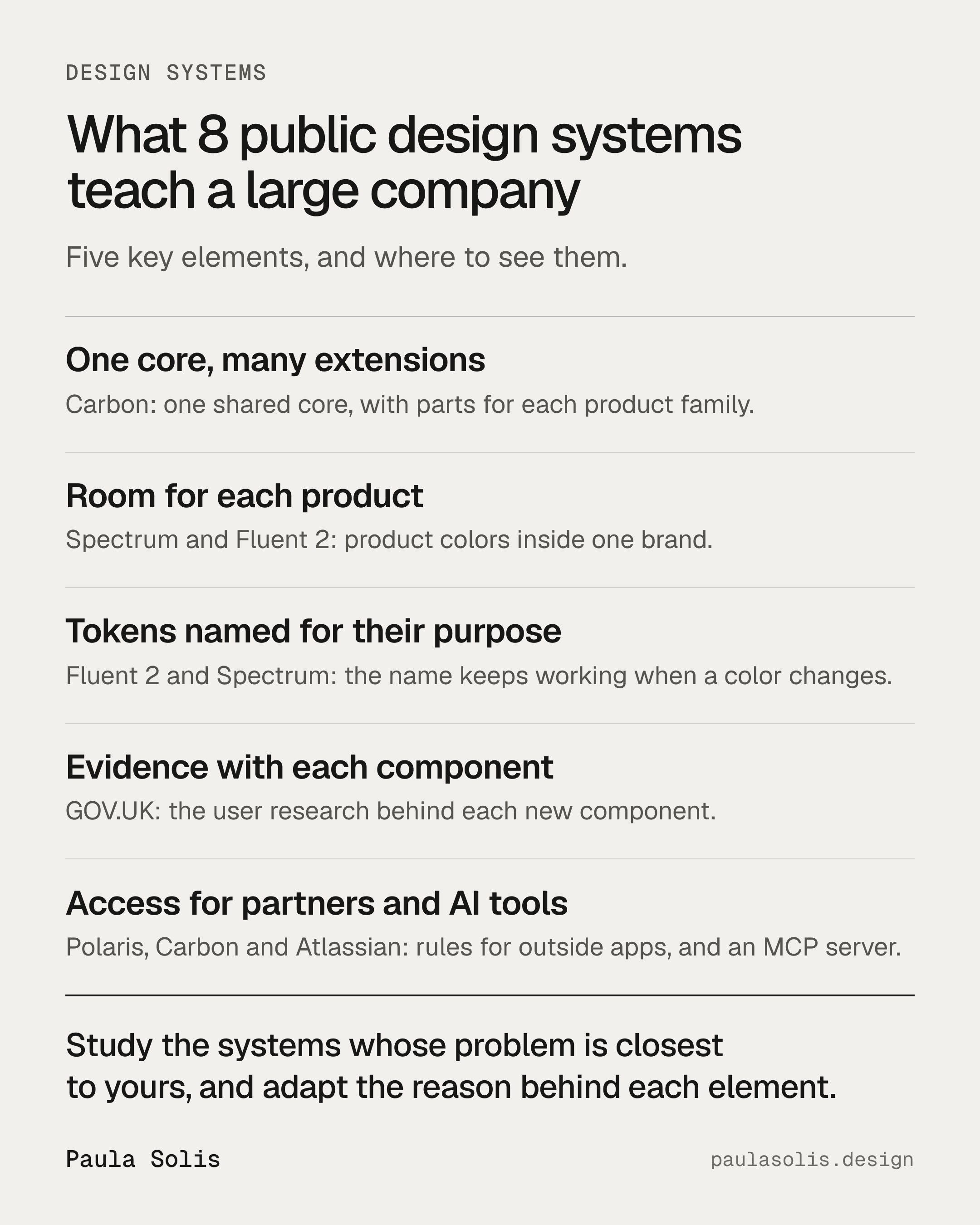
What 8 public design systems teach a large company. Five key elements, and where to see them. One core, many extensions: Carbon: one shared core, with parts for each product family. Room for each product: Spectrum and Fluent 2: product colors inside one brand. Tokens named for their purpose: Fluent 2 and Spectrum: the name keeps working when a color changes. Evidence with each component: GOV.UK: the user research behind each new component. Access for partners and AI tools: Polaris, Carbon and Atlassian: rules for outside apps, and an MCP server. Study the systems whose problem is closest to yours, and adapt the reason behind each element.
Questions and answers
What is a good example of a design system?
Good examples of a design system are Google's Material Design 3, IBM's Carbon, Shopify's Polaris, the Atlassian Design System, the GOV.UK Design System, Adobe's Spectrum, Microsoft's Fluent 2 and Salesforce's Lightning Design System 2. All eight are public. Each one publishes its foundations, components and guidance on its own site.
What are the best design systems?
The best design system to study is the one whose problem is closest to yours. For a large company with many products under one brand, study IBM's Carbon, Adobe's Spectrum and Microsoft's Fluent 2. For public services, study GOV.UK. For a platform where partners build apps, study Shopify's Polaris and Salesforce's Lightning Design System 2.
Is Material Design a design system?
Yes. Google calls Material Design 3 its open-source design system. It publishes foundations such as accessibility, content design and design tokens, plus components, a Figma kit and code for Jetpack Compose and Flutter. A team can use Material and change its colors and type to carry its own brand.
What does a design system include?
A design system includes principles, foundations such as color, type and spacing, design tokens, components, patterns, content guidance, accessibility guidance and code. Some large public systems, such as IBM's Carbon and the Atlassian Design System, also offer an MCP server, so AI tools can read the system. Not every system publishes every part.
Should a company copy a public design system?
A company should not copy the screens of a public design system. Each system was made for its own users and its own brand. Study what works and why it works, then adapt that reason to your own products. A team can also build on an open system, such as Material Design 3, and give it its own brand.
Sources (19)
- Material Design 3 (opens in a new tab). Google, 2026.
- Customizing Material (opens in a new tab). Google, 2026.
- Develop (opens in a new tab). Google, 2026.
- About Carbon (opens in a new tab). IBM, 2026.
- Carbon MCP, Overview (opens in a new tab). IBM, 2026.
- Polaris references (opens in a new tab). Shopify, 2026.
- App Design Guidelines (opens in a new tab). Shopify, 2026.
- About the Atlassian Design System (opens in a new tab). Atlassian, 2026.
- Get started, With AI (opens in a new tab). Atlassian, 2026.
- GOV.UK Design System (opens in a new tab). Government Digital Service, 2026.
- Get started (opens in a new tab). GOV.UK Design System, 2026.
- Accessibility (opens in a new tab). GOV.UK Design System, 2026.
- Brand (opens in a new tab). Adobe Spectrum, 2026.
- Design tokens (opens in a new tab). Adobe Spectrum, 2026.
- In-product word list (opens in a new tab). Adobe Spectrum, 2026.
- Design principles (opens in a new tab). Microsoft, Fluent 2 Design System, 2026.
- Design tokens (opens in a new tab). Microsoft, Fluent 2 Design System, 2026.
- Lightning Design System 2 (opens in a new tab). Salesforce, 2026.
- Global Styling Hooks (opens in a new tab). Salesforce, Lightning Design System 2, 2026.