
A product designer decides how a digital product works for the people who use it and for the business that makes it. The work covers research, the direction of the product, user flows, screens, prototypes, tests and reviews with the team. Product design is that whole job, from the first idea to the next version.
I am a Senior Product Designer, currently at Vodafone. I work from Madrid with the Vodafone strategy team in London, UK. I have 15+ years of experience in product design, design strategy and design systems. Before Vodafone I held design lead roles for six years, in agencies and in a startup. This article describes the role as I see it: what it is, how it differs from UX and UI design, the work across a week and how the role grows.
What is product design?
Product design is the work of deciding what a digital product does for its customers and how it works, in line with the goals of the business. The Interaction Design Foundation, which sells design courses, defines product design as “the process designers use to blend user needs with business goals to help brands make consistently successful products”.
The name has a second meaning. Product design also names the design of physical objects, such as furniture or devices. This article is about digital products: apps, websites and software.
The role grew with the way digital products are made. In 2016, a partner at Silicon Valley Product Group (SVPG), a company that trains product teams, described it like this:
The modern product designer participates in all phases of a product, from discovery to delivery to iteration.
Discovery is the work of learning what to build. Delivery is the work of building it. Iteration is the work of improving it after launch. A product designer takes part in all three. In the same article, Jones writes that a product designer is measured on the success of the product, rather than on the amount of design work.
What does a product designer do in a product team?
A product designer decides how the product works for the customer, together with a product manager and engineers. SVPG describes modern product designers as people who “continuously collaborate with product managers and engineers”.
I see design as a translation. Product managers bring ideas, opinions and numbers. A designer turns them into a solution that customers understand and that the team can build. The designs show engineers what to build.
| Partner | What they bring | What the product designer gives them |
|---|---|---|
| Product manager | The problem, the goal and the business numbers | A solution that customers understand and that the team can build |
| Engineers | What the system can do, and the cost of each option | User flows, screens and prototypes that show what to build |
| Management | The strategy and the budget | The evidence and the reason behind each design decision |
The mistake I see most is a design that is nice and ignores the strategy of the product. So the work starts with the business, before the first screen. I explain that part in product strategy for designers.
Product designer vs UX designer vs UI designer
The three titles overlap. A UI designer works on the interface, a UX designer on the experience of using the product, and a product designer adds the business goals and the whole life of the product. Many companies use “product designer” and “UX designer” for the same job.
UI means user interface: the screens, buttons and words that a customer sees and touches. UX means user experience. Don Norman and Jakob Nielsen, the founders of Nielsen Norman Group, wrote that user experience covers “all aspects of the end-user’s interaction with the company, its services, and its products”. They separate it from the interface, which is one part of it.
| Title | Main question | Typical work |
|---|---|---|
| UI designer | How does each screen look and behave? | Layout, type, colour and components |
| UX designer | Is the product clear and easy to use? | Research with customers, user flows and usability tests |
| Product designer | Does the product work for the customer and for the business? | Research, direction, user flows, screens, prototypes and tests, with the product manager and engineers |
The UI row follows a guide by Figma, a company that sells a design tool. The guide says that UI designers turn UX decisions into the interface: type, colour and layout. It also quotes a Figma designer who says that many companies use the two titles, product designer and UX designer, for the same role. So read the tasks in a job post before you read the title.
The work of a product designer across a week
A week mixes six kinds of work: research, direction, flows and screens, prototypes and tests, the design system, and reviews and presenting. The mix changes with the stage of the project.
- Research What other companies do, what customers need and what the business needs.
- Direction Where the product goes, agreed with the product manager and the team.
- Flows and screens The key user flows first, then the screens of each flow.
- Prototypes and tests A version that customers can try before engineers build it.
- Design system Shared components and patterns, used and improved for every product.
- Reviews and presenting Feedback on the work of other designers, and the reason behind each decision for management.
When a project arrives, I research what other companies do and what the business needs. Then I guide where the product goes.
I design the key flows and screens of a product and guide the designers who build on them. We review the work in calls, every week at the start and every two weeks later. The flow comes before the screens, because each screen needs a place in a flow. I explain how to map one in what is a user flow.
A prototype is a version of the product that people can try before it is built. SVPG writes that good product designers use prototypes as their “primary canvas” for ideas, and that they test their ideas with real customers again and again.
A design system is the set of shared components, patterns and rules that product teams build with. A product designer uses it every day, and proposes a change when a product needs something new. I write about how to redesign one in design system redesign.
How a product designer grows from senior to lead
A product designer grows by scope: from one flow to a product, from one product to several, and from your own work to the work of others.
A title depends on the scope of the company. A senior role at a large company can have more scope and impact than a lead role at a small one. I moved from lead roles to a senior role at a large company for that reason: more teams, more users.
- Owns the key user flows and screens of a product
- Makes design decisions with the product manager and engineers
- Tests ideas with customers
- Mentors other designers
- Sets the design direction for several teams or products
- Guides the designers who build on the key flows
- Reviews the work of others on a regular rhythm
- Adapts the guidance to each person
In my design lead roles before Vodafone, designers reported to me. Today I mentor designers and review their work. A lead gives guidance on the design and on the team, adapted to each person, with no micromanagement. Designers have the freedom to propose, and the lead listens. Feedback starts with what works and with the effort you see. I describe the method in how to give design feedback.
What skills a product designer needs
A product designer needs craft skills and team skills. The Figma guide names interaction design and visual design, systems thinking, research and work with other teams. I add two more: knowing the business goal of the product, and explaining each decision with its reason.
AI tools are now part of the craft. I use Claude, Claude Code, Cursor, Figma AI and ChatGPT. In my view, AI becomes the basic tool of design, as Figma replaced Illustrator. Designers will give the strategic direction, and the human eye stays the critic. AI makes mistakes, gives the average and has biases, so I check every answer an AI tool gives me.
How to start this week
These steps are for a product designer who wants a wider scope.
- Write the business goal of your current project in one sentence, and check it with the product manager.
- Map the key user flow before you open a design file.
- Test a prototype with customers before engineers build it.
- In your next review, give the reason behind each decision, together with the screen.
- Ask your manager which scope comes next: a second team, a second product or a designer to mentor.
Infographic
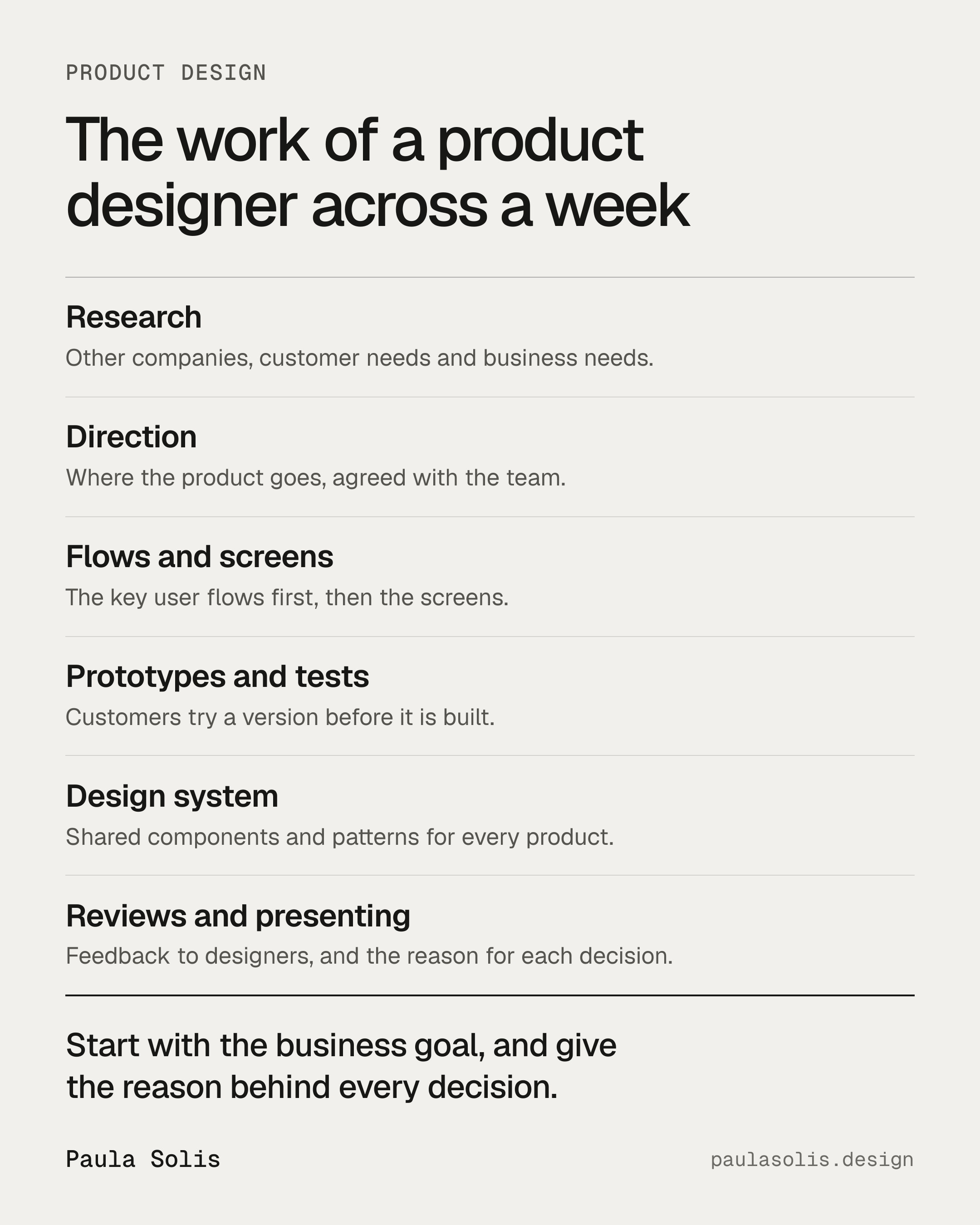
The work of a product designer across a week. Research: Other companies, customer needs and business needs. Direction: Where the product goes, agreed with the team. Flows and screens: The key user flows first, then the screens. Prototypes and tests: Customers try a version before it is built. Design system: Shared components and patterns for every product. Reviews and presenting: Feedback to designers, and the reason for each decision. Start with the business goal, and give the reason behind every decision.
Questions and answers
What does a product designer do?
A product designer decides how a digital product works for the people who use it and for the business. The work includes research on customers and other companies, the direction of the product, user flows, screens, prototypes and tests. A product designer works with product managers and engineers in every phase of the product.
What is product design?
Product design is the work of deciding what a product does for its customers and how it works, in line with the goals of the business. For digital products, product design covers research, direction, user flows, interface design, prototypes and tests. The same name also covers the design of physical objects.
What is the difference between a product designer and a UX designer?
A UX designer focuses on how clear and easy a product is to use. A product designer does that work too, and adds the business side, such as the goals of the product and its next versions. Many companies use the two titles for the same job, so read the tasks in a job post.
What skills does a product designer need?
A product designer needs research, interaction design, visual design and prototyping. A product designer also needs to understand the business goal, to work with product managers and engineers, and to explain each decision with its reason. The work now includes AI tools, and the skill to check what they produce.
What is the difference between a product designer and a product manager?
In most product teams, a product manager decides which problem the team solves and why it matters to the business. A product designer decides how the solution works for the customer, and shows it in user flows, screens and prototypes. The two work together with engineers on every decision.
Sources (4)
- The Product Designer Role (opens in a new tab). Silicon Valley Product Group (SVPG), 2016.
- The Definition of User Experience (UX) (opens in a new tab). Nielsen Norman Group, 1998.
- What is Product Design? (opens in a new tab). Interaction Design Foundation (IxDF).
- What is product design? (opens in a new tab). Figma.